Showing posts with label Local. Show all posts

November 8, 2010

Blanca (San Diego) – Seven Course Tasting Menu or Cooking Dangerously Creative

When we go out to eat we are very open in the choice of the restaurant. It can be an ethnic restaurant with a strong focus on authentic food, a bistro-style place with variations on classic dishes or an innovative high-end restaurant – in the end it is all about good or bad food which distinguishes a restaurant. But like everybody else we have our own preferred styles of restaurants which we are specifically seeking out. Restaurants which get us excited are often using creative and unique flavor combinations which go far beyond just some twists on conventional dishes. They tend to use unusual ingredients and techniques to accomplish it. These chefs have a very special way to express their thoughts on food and ingredients, and it is a stimulating process for us to try to understand what they want to express with their creation – it is “food for thoughts”. Bistro LQ in Los Angeles is a prime example of such a restaurant and has been one of our favorites since our first visit there briefly after they opened about a year ago.

Unfortunately we haven’t had many opportunities so far to experience such Chefs or restaurants of this specific style in San Diego. Only a few special tasting menus at Better Half Bistro and at Blanca under Chef Jason Neroni left us with lasting impressions as restaurants which go far beyond the usual mainstream. But going beyond the mainstream also often means that you take the risk of losing your customers, and this is not only true for San Diego but even for LA in some instances. When we had the chance to talk with Chef Neroni during our tasting menu at Blanca last December, he already sounded quite disillusioned and so it wasn’t a big surprise that he left Blanca after only a few months. His final comment that “The running joke other chefs told me was that all San Diegans want is fish tacos. It was funny for a moment, and then it got annoying because it was true.” might be too much of a generalization but it also contains some truth.

After this short stay from Jason Neroni and the underappreciation of such a creative cooking style in San Diego, we expected Blanca to become more conservative in their choice of the next Executive Chef. We were quite surprised when after a few weeks Blanca announced to appoint Gavin Schmidt. He has an impressive resume mainly focused around San Francisco. Besides Sous Chef positions at Aqua and Fifth Floor Chef Schmidt really made an impact as Executive Chef at Campton Place Restaurant and Chef de Cuisine at Coi. Both restaurants are known far beyond San Francisco as very creative and ambitious restaurants, and are much closer to the cooking style of Jason Neroni than we had anticipated. So we were really curious to check out Blanca and find out how much he might adapt his cooking style to “fit in”. The recent addition of the seven course Chef’s tasting menu at Blanca was a good opportunity for this.


Blanca is located in Solana Beach in one of the small shopping malls along the Pacific Highway. If you don’t really know where to look it is relatively easy to overlook the nondescript building.

Their distinctive “b” sign is found outside and even after you are seated.

The restaurant is separated into two parts – a bar/lounge area and the dining room. The dining room is surprisingly small with a number of cozy booths on two sides. The interior is an interesting mix of subdued elegance with some interesting lamps which reminded us of those used on older ships.
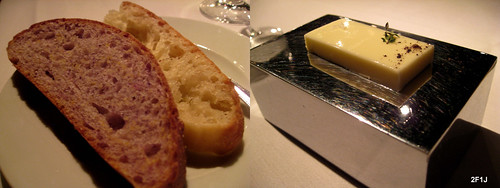
The bread was freshly baked at the restaurant and was one of the best bread services we had in San Diego. We liked the presentation of the butter on the block of steel which was slightly warm to give the butter the right consistency.

Amuse Bouche: Sea urchin, smoked avocado panna cotta, geoduck, apple, cucumber dashi vinaigrette. Over the last few years we have come to love sea urchin with its characteristic taste of the ocean. Its delicate flavor can easily get lost if not carefully paired. Chef Schmidt chose the right combination by focusing this dish on smoked avocado and sea urchin which complemented each other nicely without overpowering. The apple and geoduck gave the dish some textural variety. The vinaigrette helped to emphasize the “fresh sea” character of the amuse bouche. A very strong start of the tasting menu with more creativity than some other restaurants have on their whole menu.
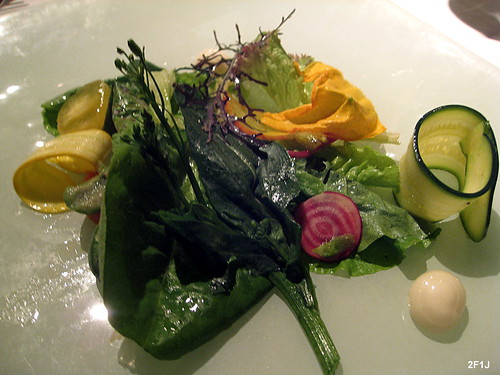
1st Course: Local vegetable composition, encapsulated caramel yoghurt.
Every restaurant talks about the importance of farm fresh food but this dish might be one of the best representations of what it really means by focusing solely on the ingredients. An impressive combination of 14-15 different examples of local produce. Some from well-known local farms, some from the restaurants own garden, some of them collected by the Chef himself who is known for his interest in foraging. Each bite was an experience of a different variation of incredible produce. But this dish also showed the Chef’s ability to combine great ingredients with newer techniques such as spherification. The encapsulated caramel yoghurt was a nice palate cleanser between the different bites of fresh produce.
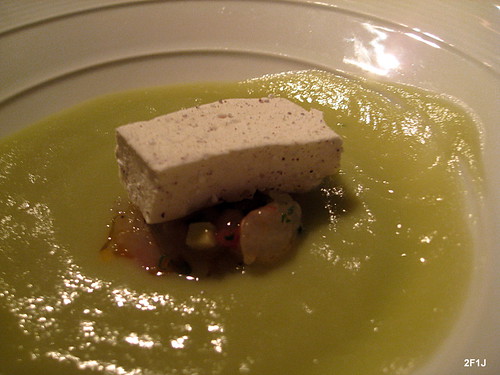
2nd Course: Fennel apple soup, spot prawn sashimi, long pepper marshmallow.
The fennel apple soup reminded us as a typical example of a fall soup. It had a nice balance between the apple and fennel in which one could clearly taste both with some basil in the background. The prawn sashimi gave some textural counterbalance. But what really set this soup apart was the marshmallow. Similar to the inclusion of fresh eggs that gives many dishes a characteristic taste/mouthfeel the marshmellow slowly started to melt and gave the soup a satisfying creaminess.
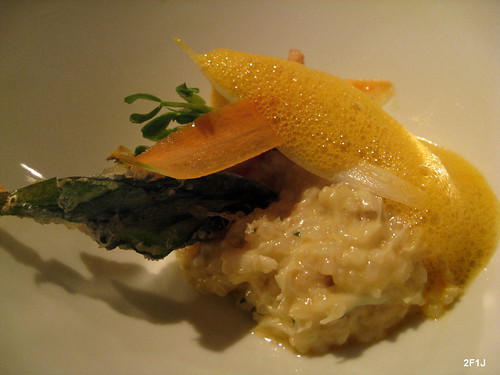
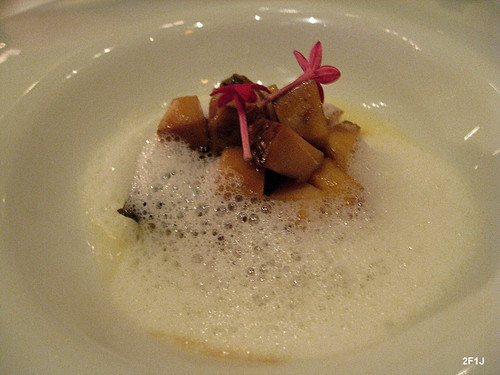
3rd Course: Dungeness crab, brown rice porridge, crab tempura, Vietnamese ram tempura, carrot lemongrass emulsion. The porridge reminded us with its creaminess of a risotto. The dish had a good amount of Dungeness crab and we liked the crunchiness of the tempura. Foams and emulsions often don’t add much to a dish and can end up as some kind of gimmick. Here the carrot lemongrass brought some freshness and slight sourness to the dish. It would have been nice to get a second portion of the dish…
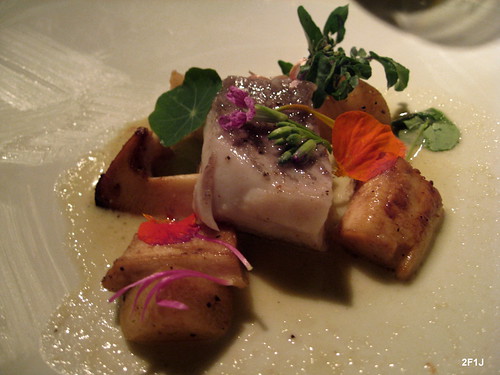
4th Course: Black cod, Matsutake, pears, wild flowers.
Perfectly seared black cod which was very moist. We liked the inclusion of pears which gave the dish some fruitiness. The wild flowers were another example of the Chef’s interest in foraging.
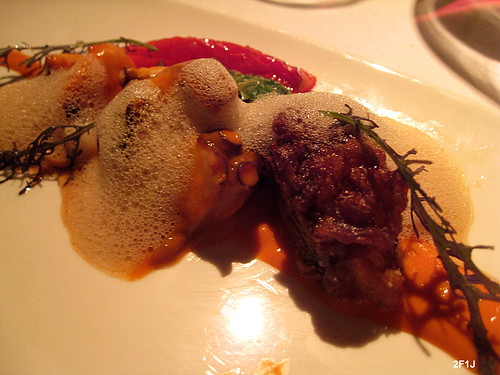
5th Course: Fried chicken and octopus, frying peppers, sesame, sassafras.
Our waiter pronounced this dish as a fun dish and we were at first not sure if fried chicken and octopus would work together but even though both kinds of meat had their distinct flavors they weren’t so different and even the consistency was quite similar. This dish was also a good example of the Chef’s use of different sauces and foams, here based on sassafras and peppers, not just as a gimmick but to really bring a dish together and at the same time adding some uniqueness to it.
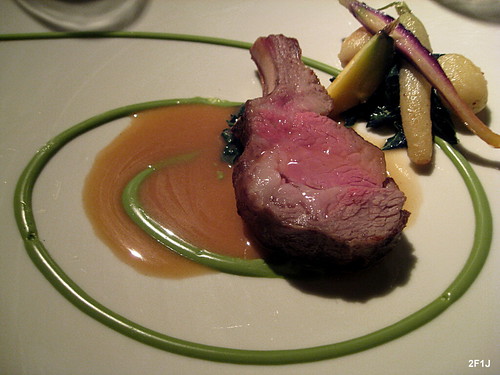
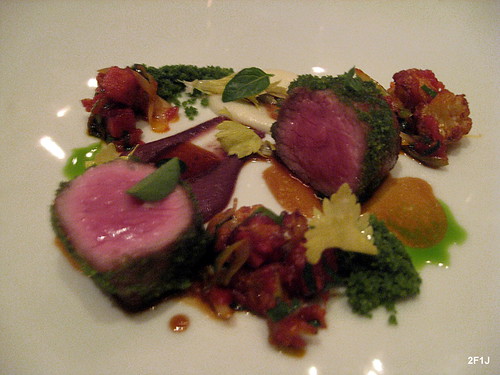
6th Course: Lamb loin roasted in hay, carrot, potato, wheatgrass.
Another dish which reminded us somehow of fall. The lamb was cooked sous-vide and had a surprisingly distinct taste of hay. The meat was very tender and had despite the hay flavor still some slight gaminess left as you expect from lamb. The spiral of aerated wheatgrass sauce was not only a nice presentation but supported the hay aroma of the dish. Another very creative dish which we felt showed the Chef’s ability to bring some unexpected dimensions to a seemingly “familiar” dish.
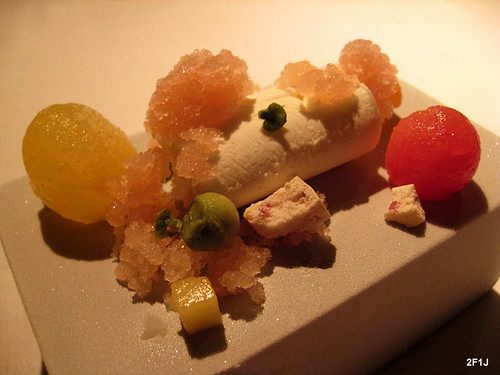
Intermezzo: Goat cheese semifreddo, melon granite, pink peppercorn meringue, fizzy melon, pineapple. We like goat cheese and we like ice cream and here we have a great combination of both together – goat cheese semifreddo. The goat cheese semifreddo had the typical slight sourness of goat cheese and was nicely accompanied by the fruitiness of the different variations of melon granite, fizzy melon and pineapple. We also liked the presentation using the same block of steel as for the butter but now frozen.
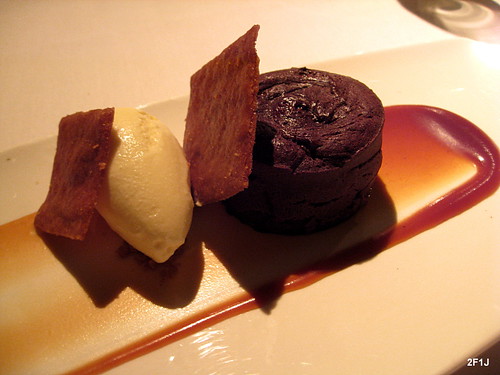
7th Course: Chocolate truffle cake, bourbon caramel, ginger ice cream.
The chocolate truffle cake had a very strong chocolate flavor but wasn’t overly dense. We really liked the ginger ice cream with its spiciness which helped to cut through the sweetness of the cake and the caramel sauce.
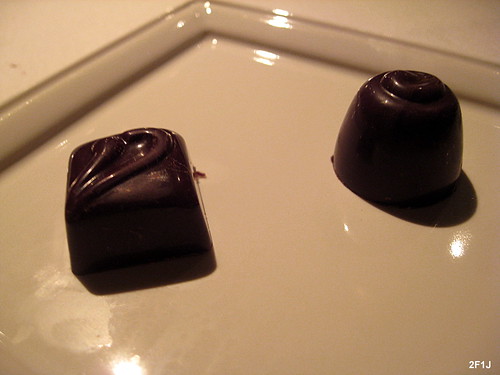
Mignardise: Coconut and coffee pralines.
Nice way to end the tasting menu and like all dishes before it was of high quality and very tasty.


We went to Blanca without really knowing what to expect. Somehow we were expecting that based on the low acceptance of the cooking style from Jason Neroni in San Diego, Blanca would push Gavin Schmidt towards a more mainstream approach covering just well established classic dishes. We couldn’t have been more wrong. Even though the cooking style of Chef Schmidt is different and more playful than the one from Jason Neroni, who prefers bolder flavors, both seem to try to push boundaries of creative and ambitious cooking in San Diego. Starting from the professional service which made it possible to have a relaxing, slow paced night to the outstanding kitchen Blanca presented for us where we would like to see restaurants in San Diego develop – creative cooking which is not afraid to explore unusual ingredients and flavor combination, utilizing all types of techniques but at the same time having a San Diego edge by using what this city (and California) stands for – some of the best and freshest produce and ingredients one can find anywhere. We really would like to see that more chefs in San Diego would be willing to take some more risks and not just cook for the lowest denominator. The restaurant business is of course very risky and nobody expects that chefs would suddenly completely change their menus but it would be very encouraging to see if organizations such as Cooks Confab, Chef Celebration or Slow Food would use their (media) influence to try to educate the customers more hat good food can be so much more than the next variation on short ribs, roasted chicken, steak or burgers. But at the same time it was not very encouraging to see that Blanca was never more than half occupied during a Saturday night, and it very much reminded us of our tasting menu with Jason Neroni. Hopefully we will have the chance to follow Chef Schmidt vision of cooking in San Diego, and this first visit was just a first glimpse of what we can expect in the future.

437 S Highway 101 # 301
Solana Beach, CA 92075-2221
(858) 792-0072
October 26, 2010

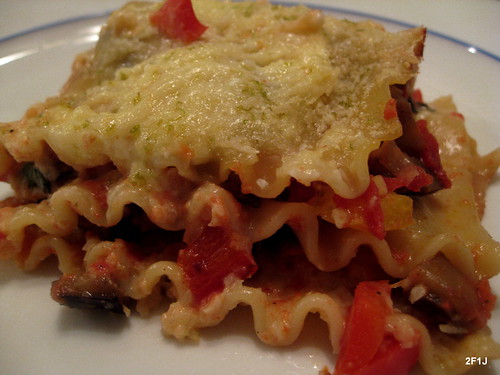
Ratatouille Lasagna with Celery Root Crème – Enjoying Local Produce

Most people associate the warm weather and the laid-back life style of San Diego and California in general as one of the main perks to live here. There is no doubt that before we moved to San Diego we mainly associated these attributes with California and are still enjoying them daily. But over the years we also more and more savor the sheer abundance of outstanding local produce. The climate of California allows farmers to grow many different types of produce year-round, and San Diego itself is one of the best places to live for outstanding local produce. According to the San Diego County Farm Bureau San Diego had in 2009 more than 6680(!) farms with most of them between just 1-9 acres which is more than any other county in the US. San Diego County is also the largest community of organic growers in the nation with 374 organic farms. Some of the well known farms have also gained a high reputation outside of San Diego, like Be Wise Ranch, Suzie’s Farms and most prominently Chino Farms.

Many restaurants started to use more and more local ingredients and to cook seasonally. Over the last few years this whole movement took off, and now pretty much every relevant restaurant claims to follow this locavore trend of using local and sustainable ingredients. When we cook at home we try to use fresh produce as much as possible but it’s not always easy to also use local ingredients. We often don’t have the time to go to one of the farmer’s markets which are the best option for local produce. Fortunately some of the local markets like WholeFoods started to include a section dedicated to local produce. On a recent visit the selection included fresh local produce from places like Be Wise Ranch, Sun Grown Organics, Aviara Farms, Stehly Farms, Suzie’s Farms and Sage Mountain Farms. Seeing this great variety of local produce we decided to use it in one dish– Ratatouille Lasagna with Celery Root Crème. Besides the pasta and Parmesan cheese all ingredients were local or at least came from somewhere in California.

Ratatouille Lasagna with Celery Root Crème

Cooking with local produce

Ratatouille is always a good choice to showcase outstanding fresh produce but since it is mainly used as a side dish we wanted to make it more substantial by including it into a lasagna dish. What really made this dish special was the béchamel sauce which was based on celery root. Celery root is one of these vegetables which are underappreciated and most people only know it, if at all, raw in a salad. But celery root is a versatile ingredient which is can also be used in soups, purees, casseroles or sauces. Its taste reminds of celery but has a more subtle, round flavor which stays more in the background. We served the lasagna with a salad of local heirloom tomatoes and cucumbers.

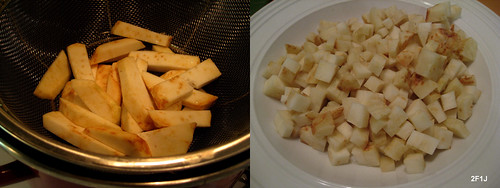
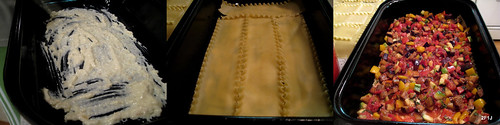
Clean celery root, peel and cut in small pieces. Steam for 15 minutes, cool and dice.

Heat butter at medium heat and cook onions for two minutes. Add flour and cook for two minutes with continuous stirring.

Slowly add milk and cream and cook for 15 minutes at medium heat.

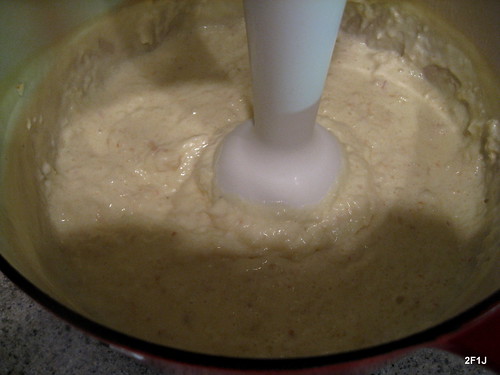
Add diced celery root and puree with immersion blender until creamy. Season to taste with lemon juice and salt.

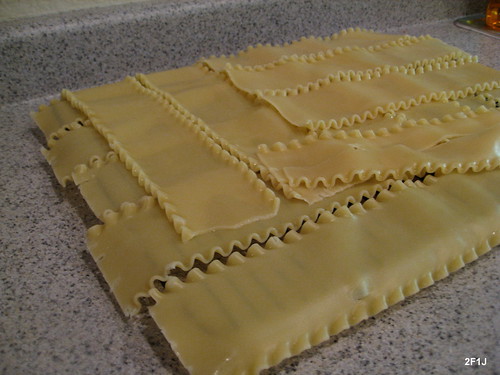
Cook lasagna sheets al dente, rinse with cold water and drain the pasta.

Heat oil at medium heat, add shallots and garlic and cook for two minutes. Add zucchini, eggplant, bell pepper and chili and cook for 4 minutes until vegetables start to soften. Season with salt and pepper and remove vegetables from pot.

Add diced tomatoes with juices to empty pot and thicken by cooking for 6 minutes. Season with salt, pepper and some sugar and mix with vegetables.

Coat the bottom of an oiled casserole with celery root crème, cover with a layer of lasagna sheets, add some celery root creme and add half of the vegetables.

Repeat everything starting with the second layer of lasagna sheets and finish with some celery root crème. Bake in a preheated oven at 200C/400F for 25 minutes.

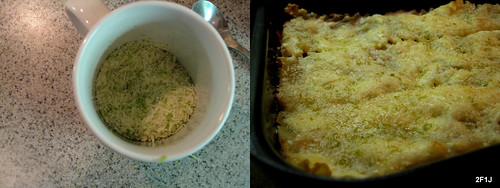
Mix parmesan with lime zest and sprinkle over lasagna. Bake lasagna for 10 minutes until golden yellow.


Recipe adapted from “Essen & Trinken”

Serves 4-6

250 g (9 oz) celery root
1 small onion
2 tbsp butter
30 g (1 oz) fluor
300 ml (1.25 cups) milk
150 ml (2/3 cups) whipping cream
2 tbsp lemon juice
8 lasagna sheets
1 can (28 oz) diced tomatoes
300 g (11 oz) zucchini, diced
300 g (11 oz) eggplants, diced
1 red and 1 yellow bell pepper, diced
2 shallots, minced
2 garlic cloves, minced
1 red chili, minced
6 stems basil, minced
4 tbsp olive oil
Sugar
30 g (1 oz) Parmesan, freshly grated
Lime zest, from 2 limes

August 22, 2010

Providence (Los Angeles) – Thirteen Course Chef’s Tasting Menu

As foodies we often feel the dilemma of having to decide if we want to experience something new or indulge into some tried classics. Might it be at home when we have to decide what kind of recipes we want to try for the next dish or when we have to determine which restaurant to visit next. The next restaurant visit might be relatively easy to agree on if it is for the city you live in, but it gets really tricky if it is for a city you just visit, even if that happens quite often. Over the last few years our travels to Los Angeles have become a regular habit and have provided us with many memorable dining memories. But every time before we go to LA it takes quite some time to nail down our culinary tour. It is always a struggle to find the best balance between trying new spots you heard or read about and some of our favorites. Our list of favorites includes rather newer additions to the LA dining scene as Bistro LQ or Animal, but one restaurant which we “discovered” early on and liked from the first course we experienced there is Providence.

Providence represents for us what fine dining is all about – very creative cuisine using the best possible ingredients, extensive multi-course tasting menus, impeccable execution in the kitchen, knowledgeable and good service without being stuffy, and a relaxing ambience. For us Providence is a restaurant for special occasions but we always make sure to “find” enough opportunities so that we can visit it more than once each year.

Providence was started in 2005 by executive chef/co-owner Michael Cimarusti and Donato Poto (co-owner and Maitre d’, formerly General Manger at Bastide). Chef Cimarusti experienced a career path similar to many high profile chefs. He graduated from one of the top-ranking schools (Culinary Institute of America in Hyde Park, NY) before working under many acclaimed chefs as Paul Bocuse, Gerard Boyer and Roger Vergé at Le Cirque in New York. During this time he also married his wife Cristina Echiverri, a pastry chef, and both decided to move to France and continue their culinary education by working at La Mareé and Arpège. After returning to New York Cimarusti became the opening chef of Osteria Del Circo. He then decided to move to Los Angeles to work as Chef de Cuisine at Spago before he became in 1997 executive chef of Water Grill. After seven years at Water Grill he finally opened his own restaurant – Providence. Providence became an instant success and got a James Beard nomination for “Best New Restaurant” in the US in its first year.

Providence has several different menu options – you can of course also order à la carte. They also offer a five course tasting menu, a full tasting menu, but every time we go to Providence we prefer to order the best way to fully experience this restaurant – the chef’s tasting menu. After ordering it you simply sit back, relax and wait for good things to come. It will be a long and exciting culinary trip.

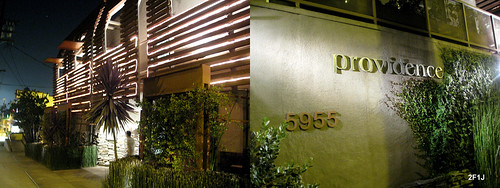
Providence is located on Melrose Ave, a little but further east of Hatfield’s and both Mozza restaurants. It occupies the old Patina building and has some interesting architectural features outside using wood which makes it easily recognizable.

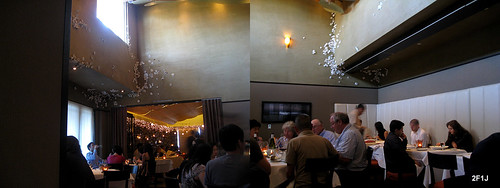
The restaurant has two dining rooms. This time we got our table in the main one. This room has mainly brown/beige colors and is a wide open space. Since we favor more private tables we often try to get one of the booth-like tables at one side of the room. The walls are decorated with barnacles and fit nicely to the seafood focus of the restaurant.

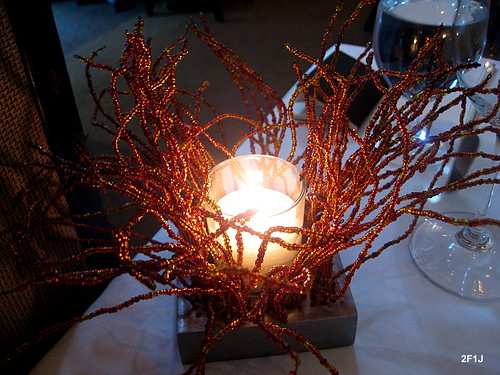
We also like the lights on the tables which resemble corals.

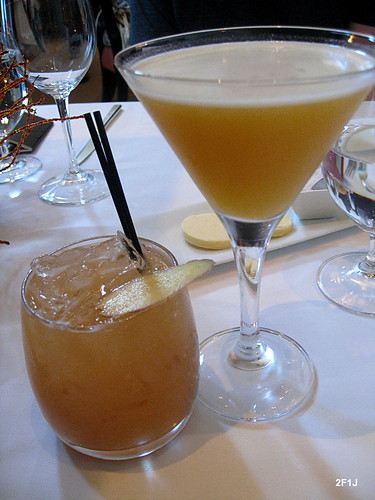
We started the night with two cocktails: Cyanide Kiss – Remy VSOP, ginger infused sake, white peach puree, licor 43, savory herb. Asian Pear Martini – Stolichnaya vanilla vodka, sake, passion fruit, monin vanilla syrup, organic pear juice. We always enjoy the cocktails at Providence which are creative and well executed. Both cocktails had a nice balance between fruitiness and alcohol. The Asian pear martini was one of the first cocktails we tried here and it is still our favorite. It’s good to know that you can also get it at Copa d’Oro, the cocktail bar of former Providence mixologist Vincenzo Marianella.

Providence has a very good bread selection with the bacon brioche as our highlight. Cute little scoop for the salt.

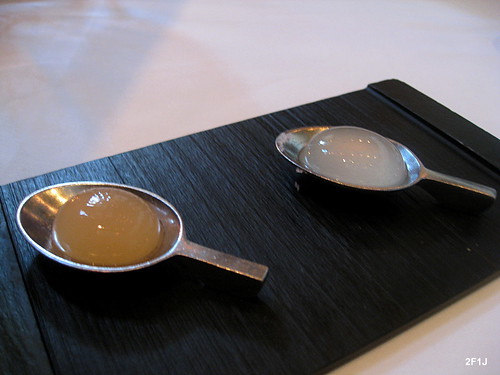
1st Amuse Bouche: Greyhound, Margarita
One of the well known amuse bouche of Providence and an interesting play on spherification. Both “cocktails” tasted very much like their real versions.

2nd Amuse Bouche: Squid and chorizo
Nice presentation of this simple but tasty course – very tender grilled squid and slightly salty chorizo eaten together give a good combination.

1st Course: Kanpachi, lemon, olive oil, black truffle
Firm but tender/buttery kanpachi was accompanied by cucumber, some lemon and black truffle but not overpowered. The olive oil gave it an additional fruity note and the crispy rice cracker some textural counterbalance.

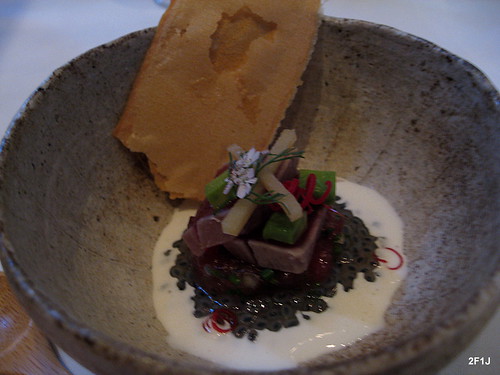
2nd Course: Big eye tuna, basil seeds, pickled ginger
Relatively fatty but very tender, slightly seared tuna with a texture not unlike very good beef in steak tartar. We liked the slightly sour combination of pickled ginger and the crème fraiche based sauce. Similar to the first course, a cracker provided some textural variety. We also enjoyed the presentation of this dish in the earthen bowl and the wooden spoon. Pairing: Junmai dai ginjyo, kanchiku – we rarely drink sake but we thought it paired nicely to this course with its light rice taste at the beginning and some floral/fruity notes at the end.

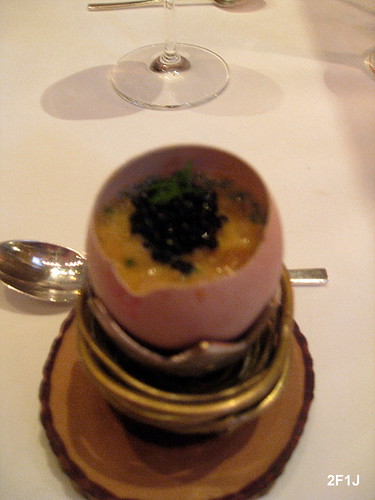
3rd Course: Santa Barbara sea urchin served in a farm fresh egg, champagne beurre blanc, fines herbes, caviar
This was one of the two courses we already had in previous tasting menus but it was a welcome repeat. The sea urchin, yolk and beurre blanc were mixed to a creamy and rich mixture whereas the salty caviar helped to cut through this richness. We wished that the taste of uni could have been a bit more pronounced. Pairing: Crémant de bourgogne “blanc de blancs,” domaine parigot & richard m.v. – Champagne blend which was not too dry or sweet with some apple aroma.

4th Course : Grilled Santa Barbara spot prawn, lemon, olive oil
This course was the second dish we already had previously,but again we weren’t sad to have it again. It was prepared by Donato Poto tableside. Many dishes at Providence are often fairly complex with many ingredients but this dish shows that simplicity can be equally satisfying. The prawns are roasted in salt and rosemary and just served with olive oil and lemon. The perfect way to eat this sweet and flavorful prawns. Pairing: Sauvignon blanc new zealand, te muna road vineyard, craggy range 2008 – Appropriate acidity for the prawns with fruit at the finish.

5th Course: Unagi and abalone, daikon, dashi, scallions
Very nice combination of flavorful freshwater eel, which wasn’t overly fatty, and tender abalone. The use of dashi foam really brought this dish together and showed that foams can be used as more than a gimmick. Pairing: Chardonnay langhe, ettore germane 2009 – Typical Chardonnay with some oak taste.

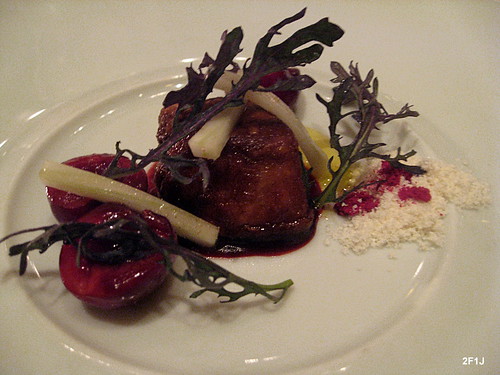
6th Course: Foie gras, cherries, mizuna, fennel
Perfectly seared foie gras paired with not too sweet cherries to balance the richness of the foie gras. The addition of anise-flavored fennel and peppery mizuna gave the dish a more complex twist compared to the regular sweetness – richness pairing of foie gras dishes. Providence often likes to work with powders of some of the ingredients. In this dish foie gras and cherry powder helped to intensify the flavors. Pairing: Riesling kabinett, kaseler nies’chen, erben von beulwitz 2007 – As expected for a pairing with foie gras the wine had some sweetness with tones of apples and peaches.

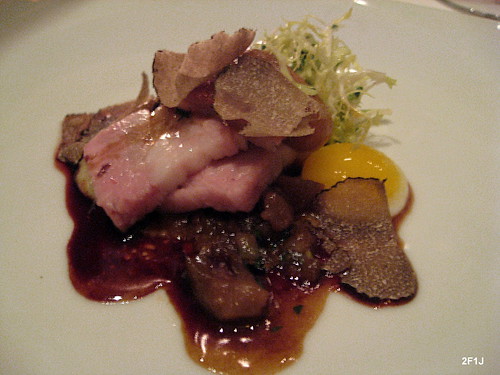
7th Course: Pork belly and porcini, polenta, summer truffles, fried quail egg, miner’s lettuce
The pork belly was very tender and had an interesting texture not unlike pastrami or meat cooked sous-vide. The sauce with fresh porcini mixed together with the quail egg was a good companion for the pork. The truffle added the desired addictive flavor without overpowering the dish. Pairing: Pinot noir, maranges le croix moines, 1er cru, camille giroud 2007 – Relatively dry wine with some sour cherry flavor.

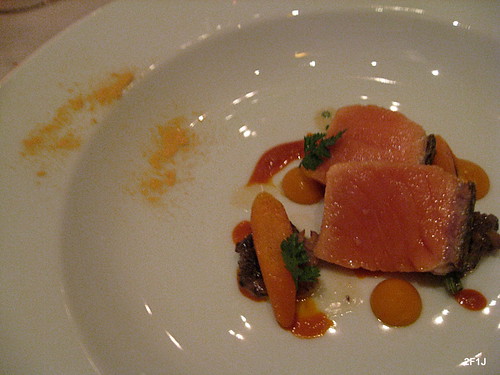
8th Course: Skeena river king salmon, hazelnuts, morels, roasted baby carrots, pea tendrils
This dish was all about the salmon and carrot flavor. Lightly seared salmon belly and roasted carrots made an unusual combination which worked nicely. The carrot flavor was boosted by the carrot sauce and carrot powder. Pairing: Pinot noir, sangiacomo vineyard, vergari 2007 – The second Pinot Noir had some acidity with spice and raspberry flavor.

9th Course: Lamb saddle, tomato compote, chorizo, cauliflower
There were a lot of things going on in this dish. Not only was this plate very colorful but also had many different flavors – slightly gamey lamb with a flavorful basil crust, sweet-sour tomato compote, saltiness from the chorizo and subtle smokiness from the roasted cauliflower – but the dish came really well together once you tried everything. Pairing: Red blend slovenia “veliko,” movia 2002 – You don’t often see wines from Slovenia on restaurant wine lists in Los Angeles. Balanced wine with notes of tobacco, leather and some berries.

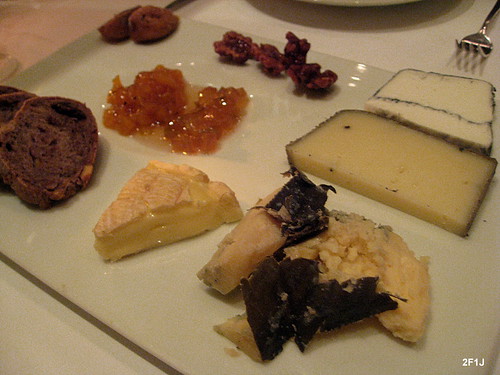
10th Course: Cheese selection
Providence has a very good selection of cheese so that we covered an array of goat, sheep and cow cheeses. Unfortunately they were out of our beloved Epoisses but had at least some Muenster. The bread and condiments, figs, walnuts, apple gelee, were good but paled in comparison to our favorite cheese plate at Bistro LQ. Pairing: Welschriesling Beerenauslese, rosenhof 2006 – Unusual pairing for the cheese course with this sweet wine. Not a bad Beerenauslese but we would have preferred a more classical pairing with a red wine.

11th Course: Coconut milk-pandan soup, thai-flavored granita, mango jelly, fried banana
Desserts are always a highlight at Providence with the impressive creations of pastry chef Adrian Vasquez. The first dessert course was no exception and showcased his strength by using many different flavors which you can taste individually but that combine in your mouth to more than just its sum. The coconut milk-pandan soup with the tapioca formed the earthy base for the fruity flavors of the granita, jelly and lightly fried banana. Very strong start for the dessert part of the tasting menu.

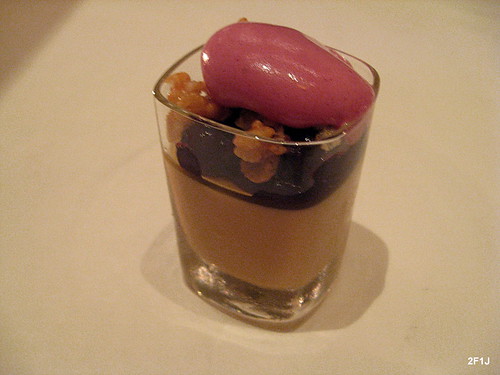
12th Course: Dulce de leche-miso panna cotta, blueberries, passion fruit & buckwheat
The use of miso for the dulce de leche panna cotta puts this dessert to the next level and gave this dish an addictive umami flavor. The blueberries and the passion fruit lightened the creaminess of the panna cotta whereas the buckwheat added some textural counterbalance. Only disappointment was not to be able to get seconds of this dessert. Pairing: Moscato d’asti “riveto,” dante rivetti 2009 – Sweet wine with some notes of honeymelon.

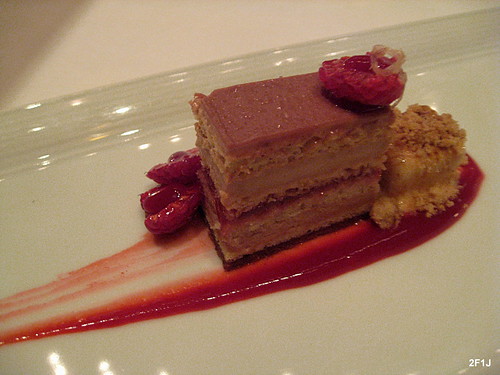
13th Course: Milk chocolate mousse, raspberry ginger, hazelnut marshmellow
A great finish to the tasting menu with the light milk chocolate mousse cake and hazelnut marshmellow.

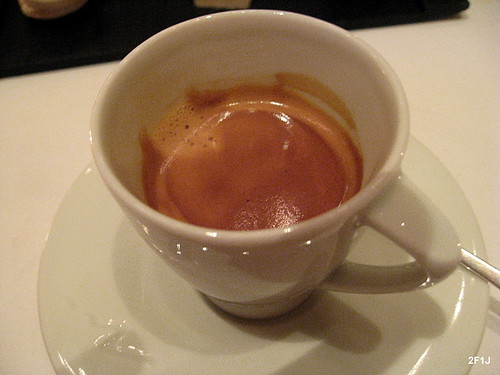
Good coffee too from LAMill which is not surprising due to the close connection between Providence and LAMill.

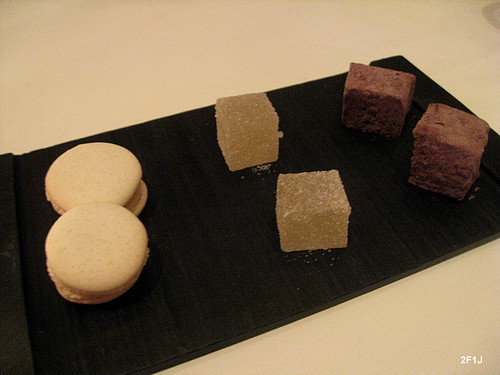
Petit Fours: And the night ended with some tasty treats

The moment we stepped into Providence we knew that it would again be an outstanding night. It is always a good sign if people who work in a restaurant remember you and welcome you with a handshake and you just start chatting with them. This time they didn’t even bother to give us a menu and just asked us if we wanted to have the chef’s tasting menu like the other times before. Part of the good service at Providence is that you never feel rushed and you immediately get the feeling that everybody there is interested to let you experience the best possible night without being overly stuffy or formal. This high level of enthusiasm of the front of the house is also easily recognizable in the work of the kitchen. The tasting menus are constantly evolving and a burst of creativity. The kitchen shows a good balance between focusing on the quality of the single ingredients and creating complex dishes with a talent for small details which improve the dish, e.g powders, foams, without being complex just to impress. Providence is often characterized as a seafood restaurant but we feel this description falls short to capture the restaurant. The meat dishes are in no way less impressive than the seafood preparations and show the depth and confidence of the kitchen. The desserts at Providence earn a specific mentioning as we feel that pastry chef Adrian Vasquez creates some of the best desserts we have eaten anywhere. And it is time for us to try one day his dessert tasting menu.
After an exiting and never boring five hours culinary trip we left Providence as one of the last guests and already on the way out we discussed when we will "find" the next occasion to come back soon.

5955 Melrose Avenue
Los Angeles, CA 90038-3623
(323) 460-4170

July 24, 2010

JSix (San Diego) – A truly seasonal tasting menu

Hotel restaurants are often places we try to avoid. They tend to be synonyms for all things we don’t like about restaurants – large, low quality food, boring menus, and often impersonal, stressed, inattentive servers. But of course there are always exceptions to the rules. One boutique hotel chain we have visited frequently in the last few years is Kimpton Hotels. Not only are we normally quite pleased with their rooms and service but they tend to have surprisingly good restaurants.

We had so far dined at Fifth Floor at the Hotel Palomar in San Francisco where Chef Jennie Lorenzo is able to create an interesting California-French cuisine and at Blvd 16 at the Hotel Palomar in Los Angeles/Westwood. At Blvd 16 Chef Simon Dolinky has a market-driven, seasonal approach to his cooking using mainly local ingredients including herbs from his own rooftop organic herb garden. This strong emphasis on local and seasonal ingredients doesn’t come as a surprise because before heading the kitchen at Blvd 16 Chef Dolinky worked as sous chef under Christan Graves at JSix at the Hotel Solamar, the San Diego branch of the Kimpton boutique hotel chain.

Christian Graves has made an impression in the San Diego restaurant scene as a chef who is a strong believer in using local, seasonal produce, organic meats and “boat-to-pan” seafood following the “seafood watch list”. As a supporter of starting from scratch cooking and working together with local farmers he sums up his cooking style as “…the food that we do should be fairly simple in concept and not totally overdone. I very much believe in slow food, in doing artisanal cooking, in using interesting ingredients“. Chef Graves developed his interest in cooking once he moved with his family to San Francisco. After visiting cooking school he refined his cooking skills and developed his own cooking style by working in several highly acclaimed restaurants in San Francisco under well-known chefs as Bradley Ogden (One Market), Aqua (Michael Mina) and especially for five years at Farallon under Mark Franz.

We had samples of Chef Graves cooking skills at different occasions, like Cooks Confab and Chef Celebration so far and always enjoyed his philosophy of simplicity and focus on seasonality. Recently we finally decided to visit JSix itself and give Chef Graves’ five-course menu a try.

JSix is located in the ground floor of Hotel Solamar at the corner of 6th and J St in a brickstone like building.

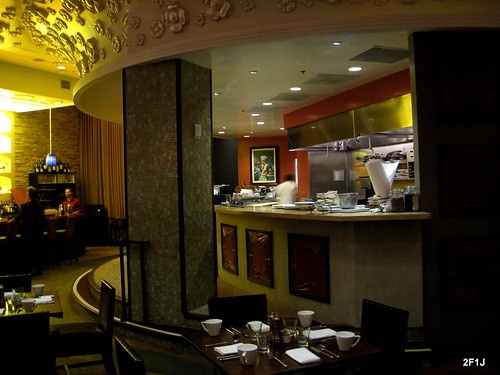
The front part of the room is occupied by the bar whereas the back of the room houses the restaurant which has a smaller number of tables and booths than we had expected of a hotel. The restaurant has a very open design which makes it not really favorable for a romantic night but is none the less cozy.

The open kitchen acts as the central point of the restaurant.

All the bread is made fresh in-house and makes it one of the best bread baskets in San Diego. The accompanying tapenade prepared with black kalamata olives, olive oil, sundried tomatoes and anchovies was intense tasting and quite addictive.

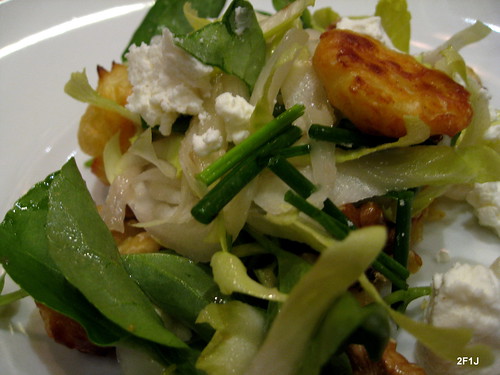
1st Course: Endive salad with goat cheese, walnuts and cheese croutons. Very good tasting endive from Suzie’s Farms with was matched by not too mild goat cheese and fresh walnuts. The vinaigrette was light but still prominent enough to support the other ingredients. A seemingly simple dish - which was a good example of how the right balance can be found so that all the key ingredients shine. Paired wine: Martin Codax, Albarino, 2006, Spain – good balance between body and acidity with rich flavors of peach, apricot, melon and light lemon zest.

2nd Course: Black cod, arugula, grape tomatoes, bread salad, bacon, beurre blanc. JSix’s take on a simplified panzanella. Similar to the first course very fresh tasting arugula and grape tomatoes with bacon bits but the focus of the dish was the perfectly prepared black cod – moist, flakey and rich tasting. The light citrusy sauce helped to support the springlike character of the dish. Paired wine: Elizabeth Spencer, Sauvignon Blanc, 2008, France – refreshing, crisp wine with strong notes of melon, passionfruit and citrus.

3rd Course: House-made wild mushroom ricotta ravioli, snow peas, fava beans, grape tomatoes, balsamic brown butter. Very good, freshly made pasta with a strong flavored mushroom filling. As a continuous theme throughout the tasting menu this dish also had very fresh and perfectly prepared vegetables which always seemed to support the flavor of the main ingredient of the respective dish. The balsamic brown butter sauce gave an acid counterbalance to the substantial ravioli. Paired wine: Chateau Bonnet, Bordeaux Blanc, 2008, France – crisp and acidic wine with notes of citrus, apple, grapefruit.

4th Course: Grilled poussin, fingerling potatoes, asparagus, tomatoes, beurre blanc. This dish was a good showcase for excellent grilling skills. The very moist poussin, fingerling potatoes and asparagus had a nice grilling, smokey taste which didn’t overwhelm the delicate nature of the ingredients. Paired wine: Trefethen, Double T, Bordeaux Blend, 2007, Napa – mixture of mainly Cabernet Sauvignon with Merlot, Cabernet Franc, Malbec and Petit Verdot. Flavors of blackberry and raspberry with a rich, long finish.

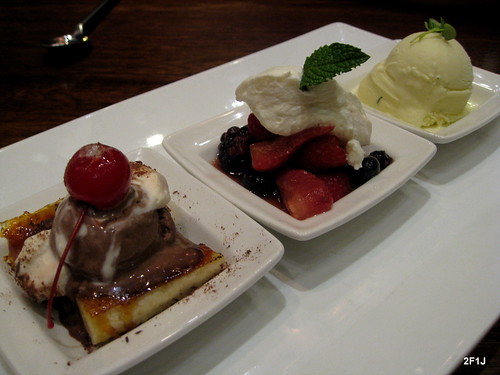
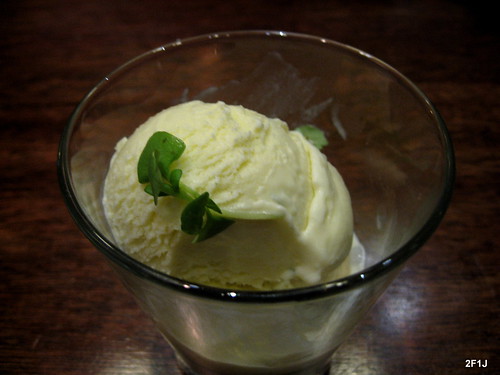
5th Course: Trio of desserts – Banana split with bruleed bananas, vanilla macerated berries and white chocolate - basil gelato. The dessert followed the theme of the night – creative dishes focusing on few, high quality ingredients. The banana split got an interesting textural spin by the bruleed bananas. The wonderful fresh flavor of the local berries got elevated to perfection by the hint of vanilla aroma. But the true highlight of the dessert for us was the white chocolate – basil gelato. First we were a bit skeptical about this flavor combination but we were proven wrong. Like two shifted waves you first taste a white chocolate flavor, after a few seconds a stronger basil flavor takes over and then both flavors slowly start to merge into one addictive flavor. One of the best gelato’s we had in a very long time. Paired wine: Chateau Liot, Barsac, Sauternes, France – not overly sweet with tones of pineapple.

When we discussed with our waiter about the tasting menu at the end of the night we mentioned how much we liked the white chocolate - basil gelato. A few minutes later he came back with two extra scoops. We were very, very happy…

Many chefs describe their cooking style as seasonal and market-driven but once you experience their tasting menus you often find only few seasonal ingredients. It is very refreshing to sample a tasting menu where the chef takes the meaning of seasonality and local serious throughout the whole night. We found it a strong statement when two out of four savory courses were vegetarian dishes showcasing local, seasonal produce. Chef Graves has a great skill of creating simple, as in few ingredients, but elegant dishes. He has a very good ability to balance his creations so that all ingredients can show their natural flavors but at the same time grow together to a dish which is better than the sum of its parts. The front of the house holds the same high standards as the kitchen. The typical laid back San Diego style is paired with professionalism, knowledge and interest in the food. It’s often the small details which distinguish good service from mediocre. When we had questions about sources of their ingredients our waiter was very knowledgeable. We asked at the beginning if they could serve the tasting European-style, also known as slow. Our waiter made sure throughout the evening that the pacing was perfect and we enjoyed a wonderful relaxing 3.5 hours dinner.

It is surprising that when people talk about great restaurants in downtown San Diego only Cafe Chloe and Cowboy Star come up (which we both like a lot, especially our “second home” Cafe Chloe) whereas JSix rarely gets mentioned. JSix is easily on the same level as these restaurants and Chef Graves deserves much more credit for his excellence. We are looking forward to visit JSix again and to follow Chef Graves on his journey through the “seasons” of San Diego.

616 J Street
San Diego, CA 92101
(619) 531-8744