February 27, 2012

Dining Room at the Ritz-Carlton (San Francisco) – Belated Farewell with a 9-Course Tasting Menu

Travel time – the best time to indulge in one of our favorite hobbies. There is hardly any day when we don’t talk about our next potential trip, and for us arranging and planning a journey is already part of the fun. First we will have long discussions where we should go next going back and forth between new destinations we haven’t visited before and revisiting places we liked a lot but never feel we have visited extensively enough. Once we decide on a place the next question circles around how we will get there – driving/flying directly or should we travel slowly with several stopovers to get to know even more locations. But the most extensive planning is always around the time at the destination itself. Starting with finding the best hotels and reading many travel review pages the most time is spent on finding the most unique points of interest and best places to eat.

There are many different ways to explore the culinary scene of any city – starting from discussion boards as Chowhound and eGullet, local newspapers to the numerous food blogs every part of the world seems to have by now. And so it is rather easy to come up with a very long list of interesting restaurants covering a wide range of cuisines for every city, but the hard part is to decide how to prioritize this list to make a final decision on the restaurants. As much as we like to explore new places there are a few cities we visit quite regularly – Los Angeles and Las Vegas are fairly close to San Diego and we go to them, especially Los Angeles, many times every year. One city which isn’t as close by but we really started to enjoy the moment we visited it for the first time several years ago is San Francisco. Over the years we kind of lost our heart to San Francisco and hope to live there at one time but until then we try to visit the city at least once a year. There are many attractive features about San Francisco far beyond just food but the vast culinary scene of the city has always attracted us and makes the selection of the restaurants for each visit fun and painful at the same time. We always try to find the right balance between the many different ethnic restaurants often with unique regional places, e.g. diverse Italian restaurants from different regions, old-established places, like Chez Panisse and high-end places with unique tasting menus. On one of our last trips we were contemplating a number of places with more conventional tasting menus to add to our mix of restaurants for that particular trip. Some of the restaurants we were considering were Gary Danko, Campton Place or Murray Circle but in the end we decided to go for the 9-course tasting menu at the Dining Room at the Ritz Carlton.

One of the aspects which attracted us to the Dining Room at the Ritz Carlton was its chef Ron Siegel. He has a quite interesting and impressive background with many diverse influences throughout his career covering several well known and influential mentors. Born in New York he moved as a child to San Francisco and started to work as a butcher at John’s Town and Country Market in Palo Alto when he was 16. During the next several years he worked at several different jobs outside of the culinary world like construction and maintenance but finally decided to focus on his culinary passion and enrolled at the California Culinary Academy. In 1991 he found his first mentor with George Morrone, opening chef of Aqua, and worked under him for two years as a line cook. Morrone was also responsible for helping Siegel to find a position at Daniel in New York under the guidance Chef Daniel Boulud. It was here that he met one of his key mentors with Thomas Keller who was in the process of opening the French Laundry and hired Chef Siegel as the opening sous chef. The successful start of the French Laundry facilitated his first position as executive chef at Charles Nob Hill focusing on the fusion of French and California cuisine. After five years he moved to Masa’s in San Francisco as the executive chef before in 2004 he took over the Dining Room at the Ritz-Carlton. Throughout his career Chef Siegel had a strong foundation from French cuisine which he combined with different other influences. Perhaps the most unusual one, Japanese, came through the one event which made him famous far beyond the close circle of foodies – becoming the first US chef in 1998 winning Iron Chef Japan in a battle using lobster against Iron Chef Hiroyuki Sakai. All these features combined let us hope to be in for an exciting and unusual tasting menu at the Dining Room.
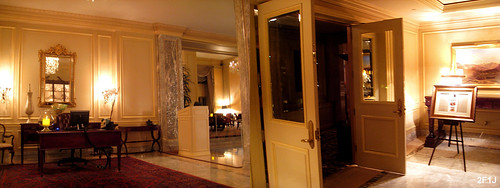
The restaurant is located inside the Ritz-Carlton Hotel in San Francisco which opened 20 years ago but is located in a more than a century old building. The hallways inside the hotel towards the restaurant are fittingly decorated to match the history of the landmark building.

The interior of the restaurant continues the theme from outside and looks very much like a restaurant from the 50s or 60s with very old fashioned décor. Once we entered the restaurant we significantly lowered the average age of the guests...
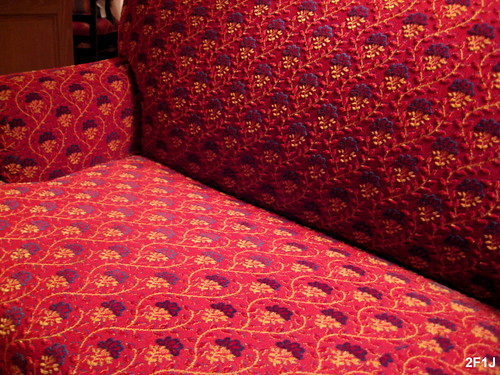
Even our seats had covers which we had last seen in one of the old movies. Overall we weren’t expecting that the Ritz-Carlton and its restaurant would be outfitted overly modern but were still surprised how old fashioned and partly also worn everything looked.
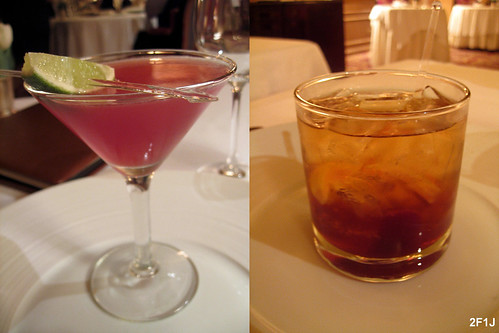
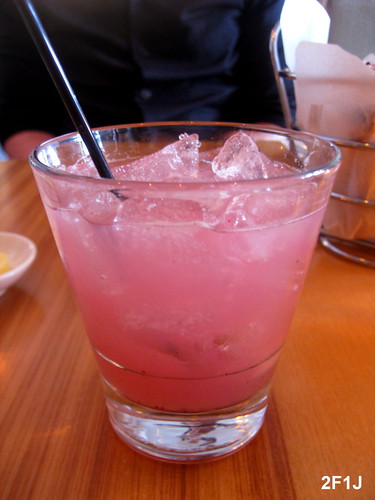
Pomegranate Martini and Old Fashioned
As always we wanted to start the night with some cocktails but that caught the restaurant a bit by surprise as they didn’t even have a cocktail menu/list but were willing to mix us something. The pomegranate juice gave the martini a good balance between sweetness and some sourness. The old fashioned was one of the better versions we had in quite some time. This cocktail often tends to be unbalanced either focusing too much on the interplay of sugar and bitters or the bourbon. In this version all three components could easily be tasted but at the same time worked perfectly together to be a true cocktail where the sum is greater than its parts.
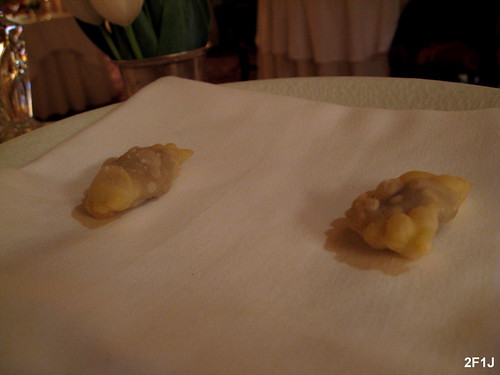
Amuse Bouche 1: Pastry, white bean paste
Somehow this amuse bouche appeared like a reminiscence to the famed Gougères at French Laundry but with a nod to Asian influence due to the white bean paste - a simple but nice start to the tasting menu.

Amuse Bouche 2: Nantucket scallops, shaved fennel
Good interplay between the raw anise-flavored fennel and the sweetness of the scallops. The fennel also had a nice textural contrast to the soft scallops.

Amuse Bouche 3: Poached quail egg, prosciutto, white truffle, brioche
Classical breakfast pairing of runny egg with some prosciutto and white truffle shavings. Lightly toasted brioche sticks to soak up the white truffle infused egg yolk – unfortunately the egg yolk was completely set and not runny so that a key component of the dish was missing. It was quite disappointing that a kitchen on that level had problems to serve a poached egg.
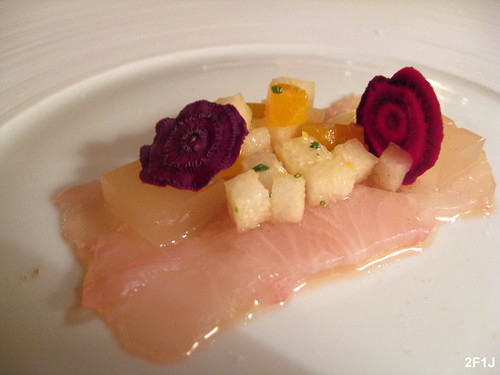
1st Course: Sashimi of Kampachi, yuzu gelee, asian pear marinade
This dish clearly showed the Japanese influences from Chef Siegel. Flawless Hawaiian yellowtail with its mild flavor and buttery, tender texture was paired with the delicate sweetness of the Asian pear and the unmistakable complex citrus and floral flavor of yuzu. A dish you could also find in a better sushi place.
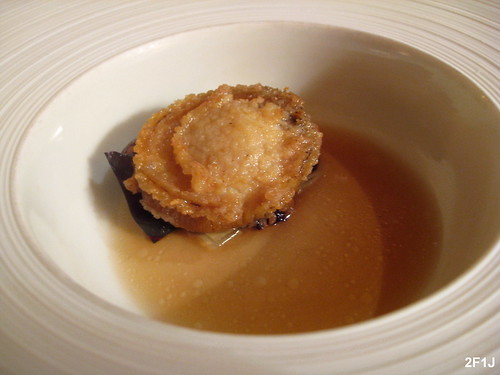
2nd Course: Abalone, shiitake mushrooms, chard, dashi broth
Abalone harvest season in California has very tight regulations due to the dwindling population over a long time and so you don’t see it often on restaurant menus. Abalone had a mild slightly sweet flavor with a not overly rubbery texture. The dashi broth enhanced the maritime flavor of the dish whereas we hoped to get some bitterness from the chard but it was hardly noticeable and didn’t add much to the dish which appeared a bit one-dimensional.

3rd Course: Black cod, elephant garlic, shortrib ravioli, watermelon radish
Pairing braised meats with fish is getting more and more common in recent times and to avoid that the braised shortribs overpower the delicate black cod Chef Siegel tamed the braised meat by using it as a filling for the ravioli. The pasta acts as a buffer between the flavors of the meat and fish and allows both of them to shine. The elephant garlic added a very mild garlic flavor to the dish whereas the braised watermelon radish just offered some texture to the dish.

4th Course: Lobster, marina di chiogga squash puree, sunchoke chips, red wine shallots
The tender lobster and the squash puree paired nicely but both ingredients have naturally a sweet component which rendered this dish on the overly sweet side. The shallots brought some welcomed slight bitterness but overall the dish was missing some balance.
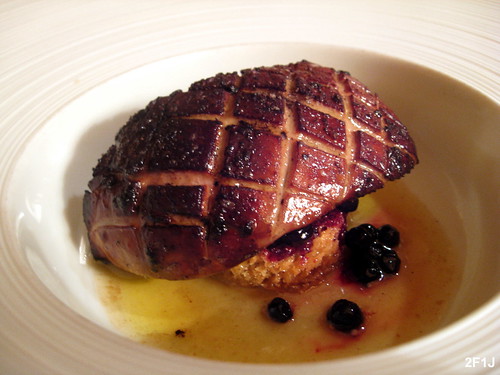
5th Course: Hot foie gras, huckleberries, brioche, rome apple juice with longpepper
A large piece of foie gras with the wonderful buttery and livery flavor one expects, expertly prepared with a slight smokey, crunchy exterior. The sides covered the well known spectrum of sweet ingredients to counteract the richness of foie gras but stayed only within established culinary boundaries. More and more chefs try, especially in tasting menus, to present unusual pairings of ingredients to explore new culinary areas. We wished that Chef Siegel would have tried something more unusual here otherwise this dish felt like a foie gras dish we had in many tasting menus before.
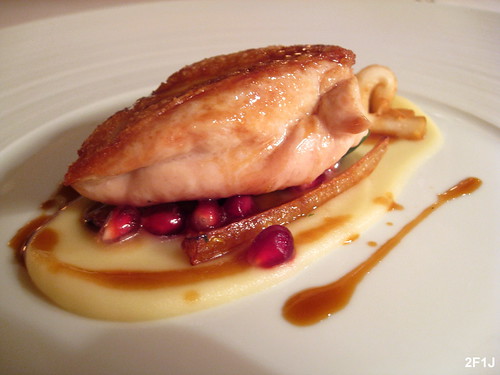
6th Course: Quail, salsify, pomegranate, matsutake, Madera sauce
One of the dishes were we saw some attempts to bridge French and Japanese flavors. Quail and salsify with the Madera sauce were classical French cuisine whereas the matsutake mushroom, even though often picked at the US West coast, is strongly associated with Japanese cooking. The strong, meaty matsutake flavor went well with the quail and the pomegranate seeds added a nice tartness and some texture. Overall one of the stronger dishes of the night.

7th Course: Beef ribeye, celery root, porcini mushrooms, sancho pepper reduction
Another dish which was very well executed on a technical level with perfectly medium rare and tender ribeye but paired, here with porcini mushrooms, celery root, potatoes, as we have seen it many times before. The sancho pepper reduction didn’t really add much to the dish and so it felt like a déjà vu with prior tasting menus.

8th Course: Cheese selection, bread, condiments
Normally we expect in such high-end restaurants that it is possible to select a few cheeses from a cheese cart. Unfortunately here at the Dining Room no cheese cart was to be seen and the selection was made for us. The bread was just regular baguette with the condiments just a few slices of apple and some almonds – one of the more disappointing cheese courses.

Intermezzo: Persimmon sorbet, carrot granite
Refreshing and unusual combination between persimmon and carrot with the vegetable providing the sweet component whereas the fruit added some tartness. A surprising palate cleanser which we wished to be much larger.
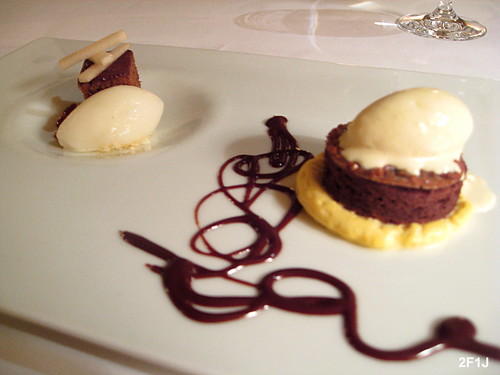
9th Course: Chocolate-layered cake, vanilla ice cream, pineapple puree, gingerbread cake, pear sorbet, caramel sauce
Dessert came with two variations of cake - both of them moist and not too heavy but also not too far from the expected norm. The dessert was lightened up by some fruit sorbet and puree but overall followed the theme of the savory courses – well made on a technical level but it felt like we had the same course in many tasting menus before.
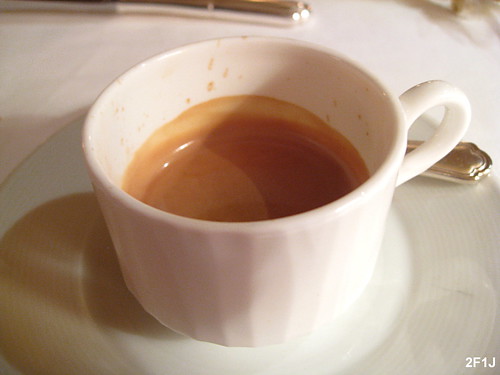
We finished the tasting menu with an espresso

Mignardises:
As much as we had hoped for a cheese cart we were surprised about the large selection on the mignardises cart and were able to taste a large selection of their very good sweets.

Ritz-Carlton hotels are not really known as edgy, modern places but once we entered the hotel we were surprised how old-fashioned everything looked and started wondering how much the Dining Room would fit in. Part of the fascination of every great restaurant is not only the cuisine and service but also the ambience which should form a coherent unit with the philosophy of the chef. Chef Siegel’s reputation was letting us to expect a tasting menu anchored in French cuisine but with modern interpretations, often including Japanese influences, and brimming with creativity. The technical execution of many dishes revealed indeed the strong French cuisine background of Chef Siegel and was mostly on a high level, perhaps with the major exception of the failed poached egg. But what we were completely missing were the creativity and surprises one expects from tasting menus at this level. There were sometimes sprinkles of Japanese influences by the use of some Japanese ingredients but mostly the dishes had either a clear French or Japanese background without many efforts to create any new directions. But even the many dishes with French influences were staying very close to the expected norm without any surprises. There was hardly any dish throughout the tasting menu were we didn’t comment how they reminded us of dishes we had eaten at other occasions before, everything felt like repeats. It speaks volume that the two things we remember most from this dinner were the intermezzo, with its unusual and successful combination of persimmon and carrot, and the huge mignardises cart – both are normally only a side notes of a tasting menu.

Besides the uninspired dishes the service at the Dining Room was far from its very good reputation. Prior to our visit we often read about the flawless and polished service at the restaurant but that was different from our experience. Starting from a very rushed service at the beginning which slowed down after we asked for a more reasonable pace to servers which didn’t really know what they were serving (and had to help each other to get together all components of a dish which they were serving) the service was simply not very professional. But worst was when the maitre’d started to bad-mouthing restaurants when talking with other guests. He compared other one star Michelin restaurants in San Francisco to the Dining Room and in particular slandered about One Market and its “horrible food and service” which was quite ironic as we just ate there a few days before and had a much better experience than at the Dining Room.

It didn’t came as a surprise when some time after our visit to the Dining Room we read that Chef Siegel was closing the restaurant to renovate and reopen it under a different name and different, more casual, concept. On one side we particularly enjoy restaurants which offer tasting menus and so seeing another one closing or changing its direction wasn’t encouraging. But at the same we felt that the Dining Room at the Ritz-Carlton was clearly past its prime and was in need of a readjustment. Perhaps this new concept will give Chef Siegel the opportunity to go back to his roots of creative cooking.

600 Stockton Street
San Francisco, CA 94108
(415) 296-7465

February 3, 2012

Cocktail 101: Tom Collins

One interesting discussion about critics, might it be for food, music, art, one often can find in blogs or newspapers circles around the question how much in depth knowledge do they need to be respected critics. There is little doubt that nearly everybody can recognize and enjoy a great meal, painting or piece of music but does it also encompass a deeper understanding of it ? Is it necessary to play an instrument to truly appreciate a musical composition or have an interest in cooking to really enjoy great dinners ? For us the interest in cooking and restaurants always went hand in hand and both benefited from each other. Cooking all the time at home really gives us a good understanding about techniques, flavors, ingredients and how they work together in any kind of dish whereas restaurant visits show us what is possible in the professional culinary world which again also influences how we cook at home. Over the years it also pushed us to try new things at home like charcuterie and cheese making as we wanted to replicate those creations we enjoyed at many places.

If somebody reads this blog on a regular basis it will be quite obvious that we often enjoy to start our dinners with a cocktail before we even start to look on the menu. And we also often end up winding down the night after a relaxed dinner with a late night cocktail at a nearby bar. But over time we also realized that different than when we read a regular restaurant menu where just glancing over the ingredient list gives us a good idea about the flavors of the final dish, reading a cocktail menu was quite different and that we lacked the knowledge about many of the spirits. So what better way to learn about and diving into the world of cocktails than by starting to build up our own cocktail bar and start making our own cocktails at home. One of the very first cocktails we tried was a Tom Collins.


The Tom Collins cocktail has a long history as it was first mentioned by Jerry Thomas, “the father of American mixology”, in 1876 and is a drink similar to the Gin Fizz with the difference of a larger amount of lemon juice, essentially making the Tom Collins a gin with sparkling lemonade. Originally a Tom Collins was made with Holland gin but by the end of the 19th century Old Tom gin (which some believe also accounts for the name of the cocktail), a lightly sweetened version of gin was used, whereas today a dry gin is preferred. Tom Collins is an ideal drink to get used to the floral, herbaceous flavor of gin as the inclusion of sugar and lemon tends to smooth out those flavor components. The Tom Collins with its proximity to lemonade is predestinated as a refreshing summer drink.


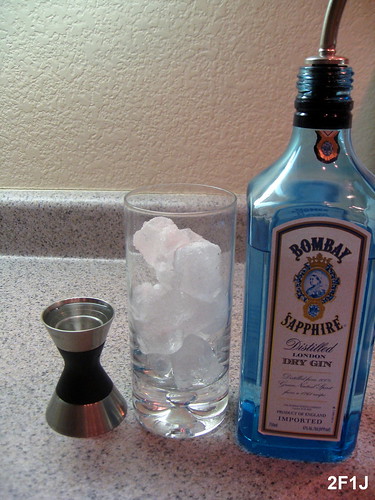
Add gin to tall glass, three-quarters filled with ice cubes

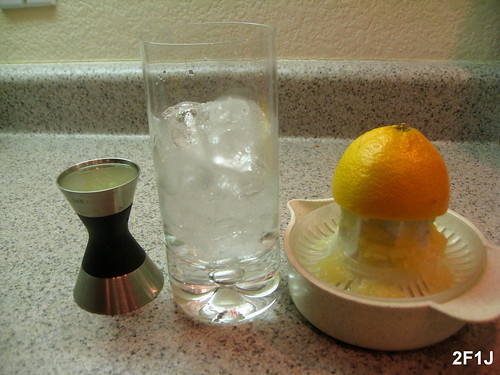
Add freshly squeezed lemon juice

Add sugar syrup

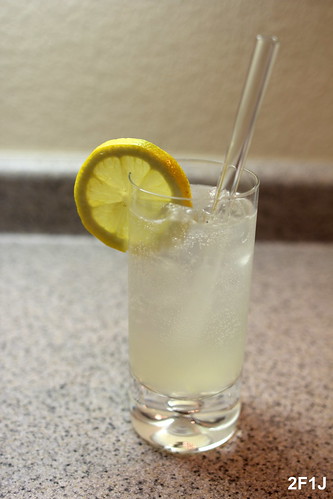
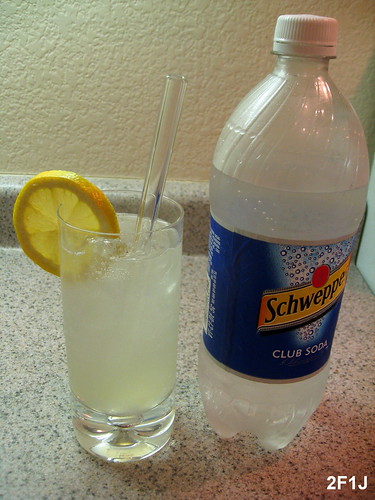
Top glass of with soda water, stir and decorate the glass with a slice of lemon


Recipe adapted from “500 Cocktails”

Serves 1

60 ml (2 fl oz) Gin
30 ml (1 fl oz) freshly squeezed lemon juice
1 tbsp sugar syrup
Ice cubes
Soda water
Lemon slice

January 6, 2012

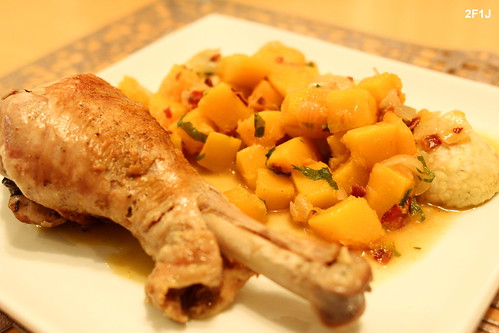
Braised Turkey Legs with Onions & Butternut Squash – Thanksgiving Dinner for the Small Family

Thanksgiving is normally for us a good reason to take time off and travel around. The last few years we went to extended trips to San Francisco and Las Vegas and so didn’t really have to worry about what to cook for Thanksgiving. This year with a new baby we didn’t feel she was old enough yet to travel for a longer time and decided for the first time in six years to stay at home during the holidays, which also meant we had to think about what we wanted to cook for that special day. Even though Thanksgiving isn’t really known and celebrated in Germany and so isn’t associated with a special dish or ingredient we felt that we should try to capture the spirit of this holiday in the US with our dish. At the same time the idea to cook a large turkey and having turkey leftovers for the next several weeks wasn’t appealing to us as normally we try to avoid eating the same thing again and again as it gets boring very fast. We thought about using some other poultry or just braising some beef for this occasion but somehow it didn’t feel right for Thanksgiving.

When we started to look into the history of what was served for Thanksgiving in the US it became very fast clear that turkey was now for centuries the preferred main dish for Thanksgiving. There are several different theories why turkey is the preferred meat for Thanksgiving including one with Queen Elizabeth who celebrated during a harvest fest the news of the destruction of the Spanish Armada on its way to England with a roasted goose which later became a turkey when the pilgrims arrived in America. But the most likely explanation might be also the most unexciting one – cows and chickens were too valuable, pork not fit for a special occasion, venison would require hunting and geese were more difficult to raise so that turkeys remained as a best choice – cheap, plentiful and easy to raise.

And so it was clear for us that we would have to have turkey for Thanksgiving but instead of cooking up a whole one we decided to pick up one of the tastier parts - legs. Since one of the main problems with roasting a turkey is often that they end up dry we thought that braising would resolve this issue and yield a moist piece of turkey. And what better to capture the fall season with a Thanksgiving dish than also to include squash so that in the end we settled on Braised Turkey Legs with Onions & Butternut Squash.


The turkey legs turned out to be as moist as we hoped for and had the right consistency of being very tender without being too soft. We prefer the dark meat flavor which can stand up against stronger tasting side dishes compared to the often rather flavorless white meat. Braising of course has the disadvantage that even though it will not provide you a dried out piece of meat it can’t give you the crispy skin which is often a very nice feature of poultry. But the major drawback for us was that the turkey legs had still some tough tendon/connective tissue that didn’t soften enough even after braising and which required some knife work to still enjoy the turkey. As much as we enjoyed the meat the real star of the dish for us were the vegetables and the sauce made of out the braising liquid and pancetta. Both butternut squash and sweet onions provided a wonderful foundation for the whole dish with a combination of sweetness and certain earthiness characteristic for especially winter squash. The vegetables were also briefly braised in the braising liquid of the turkey legs which helped to permeate the vegetables with the herbs and the crumbled pancetta completed this dish. Next time we will try to braise the legs for a longer time at a lower temperature to remove all connective tissue and it should make this dish perfect as great meal for a festive day.

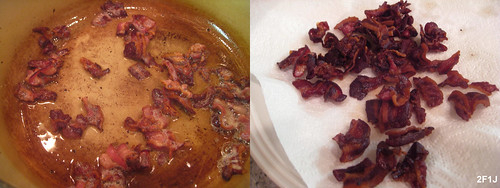
Heat butter in skillet over medium-high heat and sauté pancetta for eight minutes until crisp and brown. Transfer pancetta to plate lined with paper towels to drain and remove half of the pancetta fat to a jar. Preheat oven to 150 °C/300 °F.

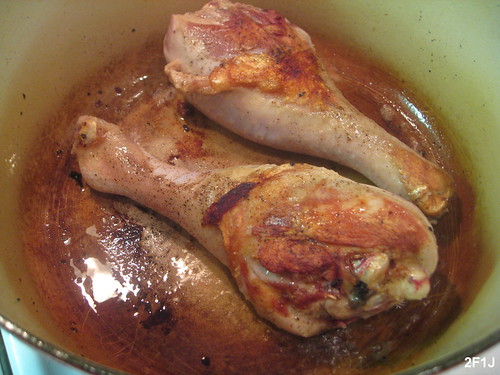
Season turkey legs with salt and pepper and sear thighs on both sides for six minutes per side. If skillet is too small do this in two batches to avoid overcrowding the skillet. Transfer legs to plate.

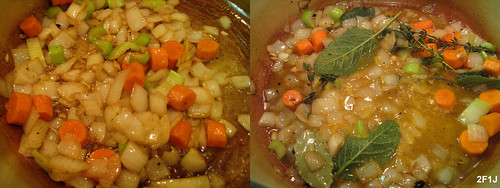
Add onion, carrots, celery and garlic to skillet and season lightly with salt and pepper. Saute vegetables for five minutes until they start to brown. Add thyme, sage, bay leaf and orange juice and deglaze skillet by bringing the orange juice to a strong simmer and scraping bottom of the pan. Simmer orange juice for one minute until reduced by half.

Add the turkey legs and stock to vegetable mixture and bring to simmer. Place skillet in oven and braise for 70 minutes with turning the legs once after 30 minutes.

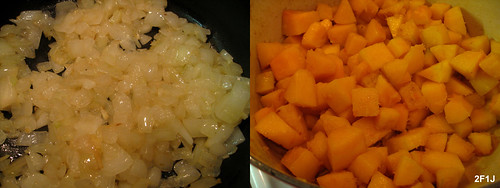
While the legs are braising heat reserved pancetta fat in another skillet over medium-high heat, add onions and garlic and some salt and pepper and sauté the vegetables for 12 minutes until browned. Transfer vegetables to plate. Add butter to skillet and sauté squash for ten minutes with frequent stirring until browned. Remove from heat and set aside until legs are done.

Once turkey legs are finished braising remove them from skillet and cover them with foil on a plate to keep warm. Strain the braising liquid and discard the vegetables.

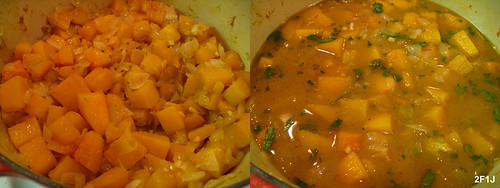
Return squash to medium-high heat, add the onion garlic mixture and sauté for two minutes. Add the braising liquid with the sage and parsley, cover the pot and braise the squash over low heat for 15 minutes until tender. Crumble the reserved pancetta and add to the squash mixture. Increase the heat to high and cook for two minutes to thicken the sauce. Taste for salt and pepper. Serve with turkey legs.


Recipe adapted from “All about Braising”

Serves 4

1 tbsp butter
120 g (1/4 lb) pancetta, diced
4 bone-in, skin-on turkey legs
1 yellow onion, coarsely chopped
1 carrot, coarsely chopped
1 celery stalk, coarsely chopped
2 garlic cloves, minced
3 thyme sprigs
2 sage sprigs
1 bay leaf
120 ml (1/2 cup) freshly squeezed orange juice
240 ml (1 cup) chicken stock
450 g (1 lb) sweet onions, coarsely chopped
2 garlic cloves, minced
1 tbsp butter
950 g (2 lb) butternut squash, peeled, seeded and cut into 1-inch chuncks
¼ cup flat-leaf parsley, chopped
2 tbsp sage, chopped

November 30, 2011

Kitchen 1540 (San Diego) – 20 Dishes, 10 Courses – White Flag Tasting Menu

Our interest in everything about food, cooking and restaurants isn’t much of a secret to our co-workers and so it is not surprising that often discussions at work center around these topics. One question we are asked regularly is about the best restaurant and special memorable meals. It is impossible to answer about “the” best restaurant as we like a broad spectrum of restaurants ranging from small ethnic hole in the walls to high-end upscale restaurants and it really depends on the occasion and mood which ones we prefer on a given day. And so it is easier to just agree on general criteria for a good restaurant – quality of food and service paired with a fitting ambience. The more interesting question is about special memorable meals and how they are defined for us. Even though we are not fixed on one particular cuisine it became more apparent for us over the years that we truly remember and discuss for a long time those dinners in restaurants which are trying to combine unusual flavor and ingredient combinations far outside of what the majority of restaurants are serving often incorporating modern techniques. Most of the restaurants we enjoy most, like Bistro LQ, Saam or Coi are located in Los Angeles and San Francisco. San Diego has a number of restaurants we have on our heavy rotation list but for a long time none of them really belonged to the list of restaurants for one of these memorable dinners. At the same time the background and reputation of several chefs in San Diego is on par with their peers in LA and San Francisco and so we often wondered if there are hidden gems in San Diego we are missing. More recently we decided to focus on finding those unique restaurants in San Diego and were quite happy to indeed find those special places like Blanca under Gavin Schmidt and Rancho Valencia with Aaron Martinez.

Encouraged by these findings we decided recently to contact more restaurants in San Diego to discuss with several chefs if they would be interested in preparing special tasting menus without any limitations. One of the restaurants which was on the top of our list was Kitchen 1540 in the L’Auberge Hotel in Del Mar. The restaurant under Chef McCabe was our very first fine dining experience in San Diego several years ago when it was still named J. Taylor. But we still discuss today some of the dishes we had like a venison entrée or a dessert with a selection of different crème brulees. Paul McCabe, born in Arizona, started his culinary career as an apprentice under Chef Michel Blanchet at the L’Ermitage in Los Angeles. Over the next few years Chef McCabe held different positions with increasingly more responsibility at restaurants in California, Arizona and Hawaii including Sous Chef and Chef de Cuisine at the Enchantment Resort, Sous Chef at the L’Ermitage before in 2001 he finally settled in San Diego as Executive Chef at Top of the Cove. He moved in 2002 to the Star of the Sea before becoming Executive Chef at J.Taylor which after extensive renovation in 2008 reopened as Kitchen 1540.

After some email exchange with GM Bryan LaFontaine we finally settled on a 10-course White Flag Tasting Menu where we served up to ten courses but could “throw up the white flag at anytime we feel that we cannot eat anymore”.

Hibiscus Caipirinha: Leblon Cachaca, Domaine de Canton, fresh lime, house made hibiscus syrup
We started the night with an interesting twist on this classical Brazilian cocktail which got some refreshing floral notes from the hibiscus syrup balanced by the ginger liqueur.

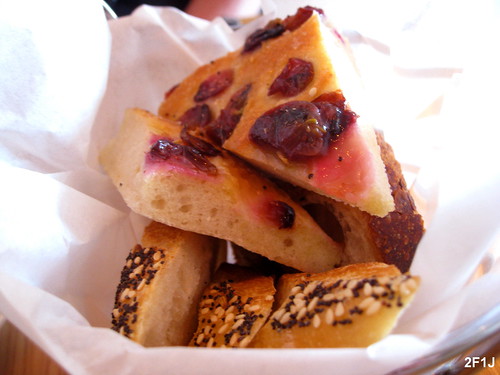
Bread Service: Kitchen 1540 serves several different breads for the bread service.  Most of the selection is decent with the highlight of the grape-fleur de sel foccacia

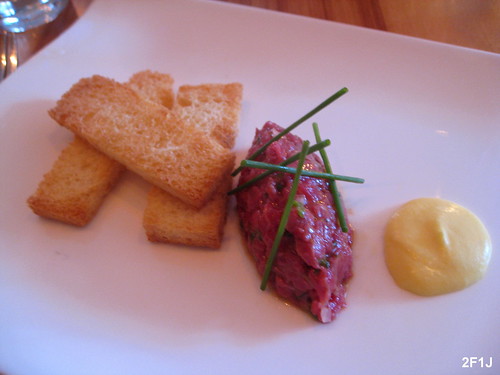
Course 1A: Bison tartare, smoked bacon Sabayon, brioche, chives
We had many different tartars so far covering beef or venison but this was the first time with bison. The bison had a surprisingly strong and rich flavor with some subtle background notes from the mixed-in lemon oil. The bacon sabayon added a complementing smoothness to this excellent dish.

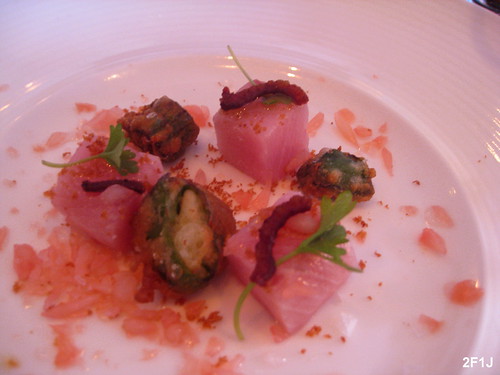
Course 1B: Hamachi crudo, shishito peppers, grapefruit supremes, shaved bottarga
We expected to get the same courses throughout the tasting menu but were surprised when our server brought us two different first courses and mentioned that Chef McCabe was planning to continue so for the entire menu so that we had a chance to taste more different dishes – a nice and welcome surprise. Here we had some beautiful pieces of hamachi with a firm but yet melting, tender consistency which were paired in a classical fashion for crudo with a sour-salty-peppery mix consistent of grapefruit, bottarga and shishito peppers. A very good example of McCabe’s approach to show his own interpretation of well known dishes by adding unexpected but yet fitting components.

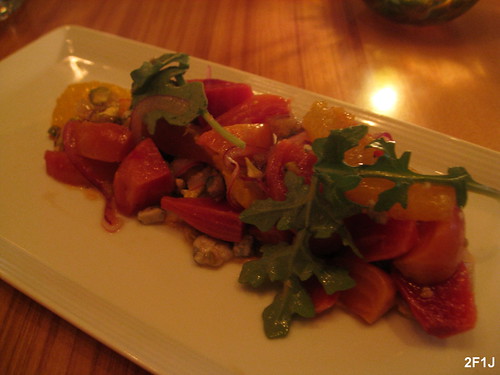
Course 2A: Organic beets, Valdeon blue, pistachio brittle, caramelized yogurt
Beets can be a difficult ingredient to work with as it easily can overshadow a dish with its earthy sometimes even muddy flavor. And so we like beets as part of a dish but are often wary about it as the main ingredient. Here we have a prime example how it can take the center stage but its flavors are impressively incorporated into the whole dish – tender beets perfectly cooked so that they also show their subdued natural sweetness are nicely balanced with the sharpness and saltiness of the strong cow and goat’s milk cheese whereas the pistachio brittle not only gives a textural contrast but also some appreciated sweetness.

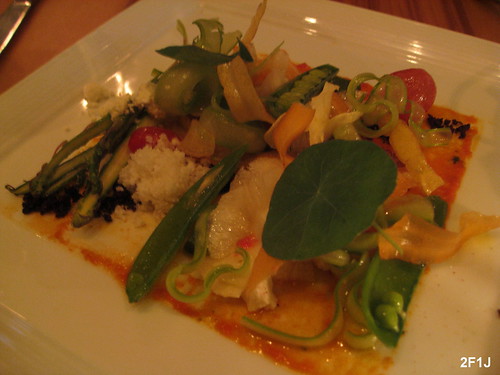
Course 2B: Farm house salad - organic vegetables, sundried tomato puree, pistou gelee, orange blossom vinaigrette
It’s interesting to see that some of the fine dining restaurants, like Blanca and Rancho Valencia, had on their recent tasting menus some interpretations of salads showcasing the abundance of outstanding local produce covering it from very different angles. Whereas Blanca’s approach focused on the flavors of the produce itself with very minimal distraction from anything else, e.g. vinaigrette, Kitchen 1540 incorporated the produce in a much more complex dish with many different flavor components including some dehydrated goat cheese, sundried tomato puree, orange blossom vinaigrette and olive powder. Both variations were very different but highlights of their tasting menus and for us a kind of “signature dish” for San Diego.

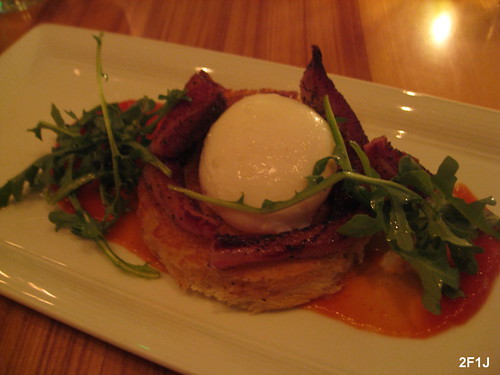
Course 3A: Bacon & egg - house made pancetta, 62°C egg, brioche, smoked ketchup
There are dishes where you immediately known that they are a success when they are brought to the table even before you taste them. What can go wrong if you combine pancetta, a runny egg and some brioche and perfected by some tangy ketchup and arugula to cut through the richness. A dish you want to have for breakfast every day.

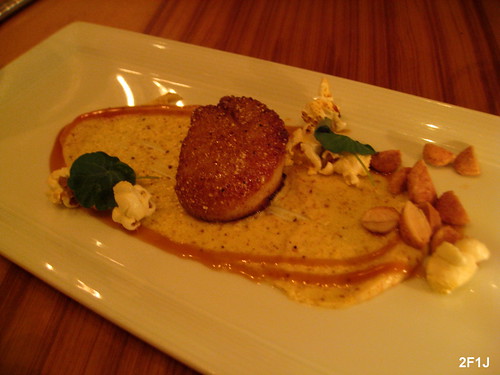
Course 3B: Diver scallop, popcorn puree, candied almonds, salted caramel, nasturtium
The combination of tender diver scallop and popcorn puree with its intensified corn flavor worked surprisingly well. The candied almonds gave some additional sweetness and textural contrast to the dish and so the salted caramel played a key role as it provide some much need saltiness to counter the sweetness of the other ingredients.

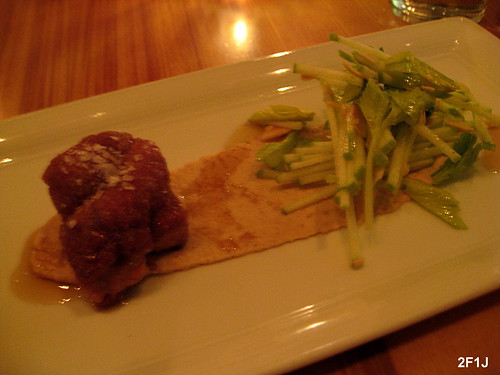
Course 4A: Pan roasted sweetbreads, smoked almond milk, blis maple, apple celery salad
Too often sweetbreads are covered in a thick crust of breading so that it is hard to discern their natural flavor. Here we had a perfectly roasted sweetbread without any distracting coating just with a crisp outer layer and a creamy core. The apple celery salad gave a refreshing touch to the dish whereas the smoked almond milk acted as overarching component pairing nicely with the sweetbreads and the apple celery salad independently.

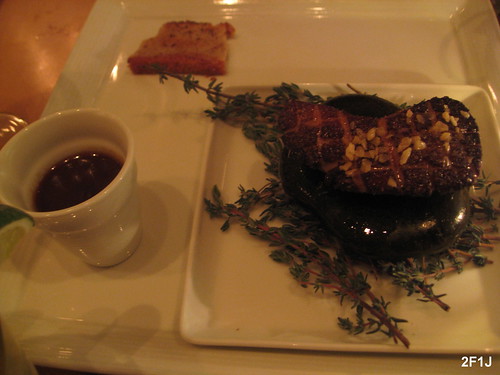
Course 4B: Stone seared foie gras, tangerine pop rocks, tangerine reduction, black pepper financier
Very interesting preparation and presentation of a flawless piece of foie gras seared by the hot stone. The thyme under the hot stone added an enticing aroma component to the dish. The tangerine reduction proved to be sweet enough to cut through the richness of the foie gras but not to be overly sweet to dominate the dish. The tangerine pop rocks were a nice gimmick adding some acidity whereas the black pepper financier had some noticeable spiciness from the pepper.

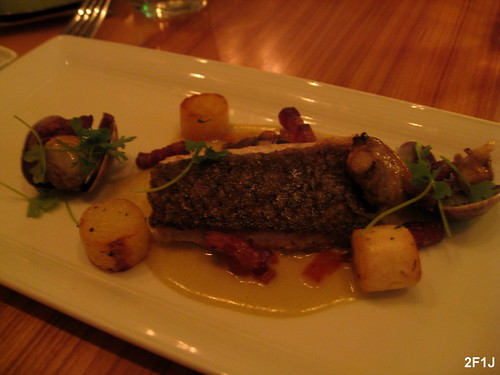
Course 5A: Pan seared Barramundi, clams, Yukon potato, pancetta, celery, Tabasco
This dish was a play on a deconstructed clam chowder centered around the moist barramundi with its crispy skin. The clams brought some of their characteristic brininess which was enhanced by the saltiness of the pancetta. The potato and the celery acted as the base of the dish with earthiness and tied the components of this successful “clam chowder” together.

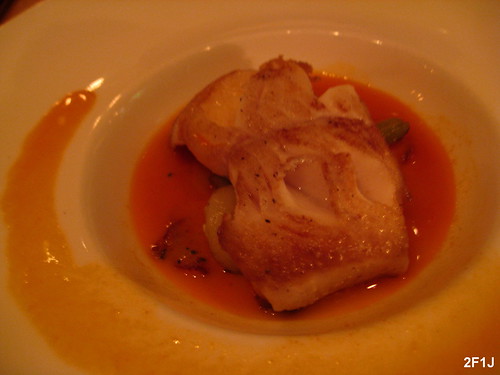
Course 5B: Pan seared Black Cod, cipollini onions, fingerlings potatoes, chorizo-mussel broth
Conceptionally a similar approach but with a different flavor profile as the other fish dish – centered around the very flaky black cod, a good combination of brininess and saltiness from the chorizo and mussel broth and again potatoes, this time accompanied by cipollini onions, as the base of the dish. Both dishes showed that the strength of Kitchen 1540 of working with fish.

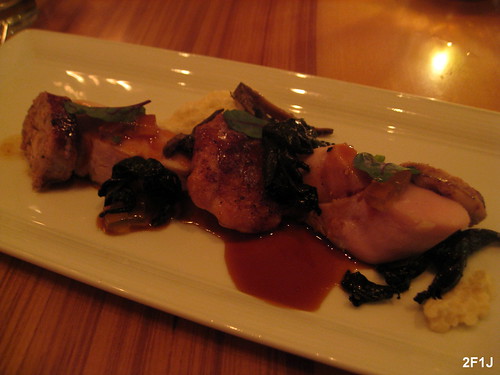
Course 6A: Organic chicken – sous vide breast, crispy thigh, chicken-fennel sausage, lobster mushroom, scrambled cauliflower, jalapeno-apple gastrique
Chicken is often dreaded in tasting menus as too boring and flavorless but here we had an impressive take on different parts of the chicken – chicken breast which was cooked by sous-vide to ensure a very tender and moist piece, crispy, flavorful thigh and housemade chicken sausage. The jalapeno-apple sauce was a key part of the dish as it added a complex sweet-sour-spicy mix which lightened up the preparation.

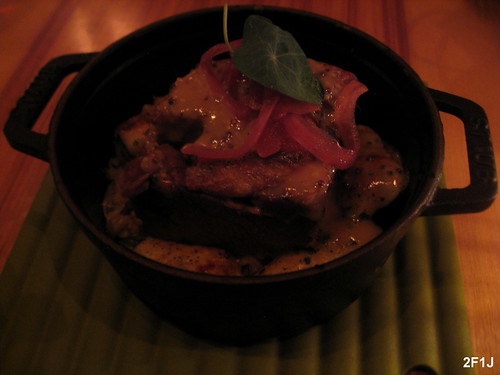
Course 6B: Braised Kurobuta pork shoulder, herb gnocchi, braised cabbage, bacon, pickled onion
The most rustic dish of the tasting menu was appropriately served in small Staub cocotte. The braised pork shoulder and cabbage was quite close to dishes we have made at home but what elevated this dish for us were the herb gnocchi – light and fluffy yet with distinct flavor supporting the braised ingredients and at the time they transformed the dish to a surprisingly light course.

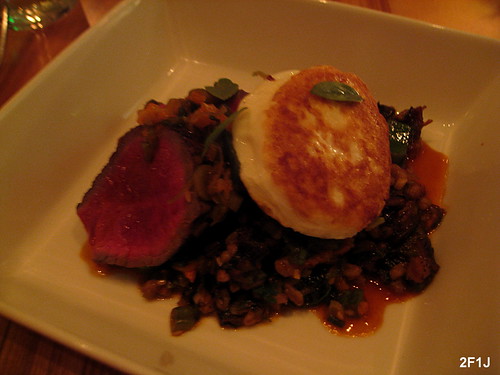
Course 7A: Natural beef tenderloin, kim chi fried farro, fried egg
Farro is one of the grains you don’t see too often on menus which is a shame as it has a wonderful nutty flavor which works nicely with many different dishes. Here is was quite uniquely combined with kimchi to give the dish a subtle sour character which paired well with the tender, sous vide cooked, beef tenderloin and the fried egg. The dish appeared to be a strange combination of components which didn’t really fit at first but really grow on us after a few bites.

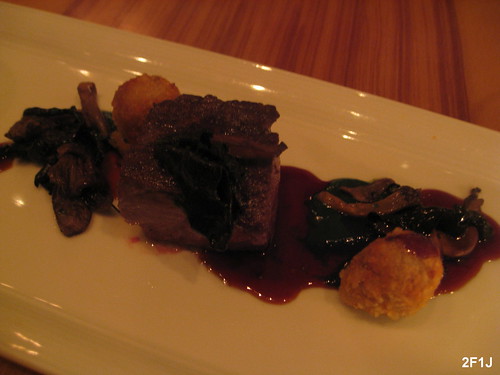
Course 7B: Pork belly, smoked potato croquettes, lobster mushrooms, tomato-cabernet reduction
Pork belly might be one of our favorite cuts of meat and it didn’t disappoint here - very tender with a crisp skin it clearly showed all the strong points one expects. Even though the pork belly took the center stage in this dish it was fittingly accompanied by potato croquettes which could have a stronger smoked flavor and the tomato-cabernet reduction which added some acidity to cut through the richness of the pork belly.

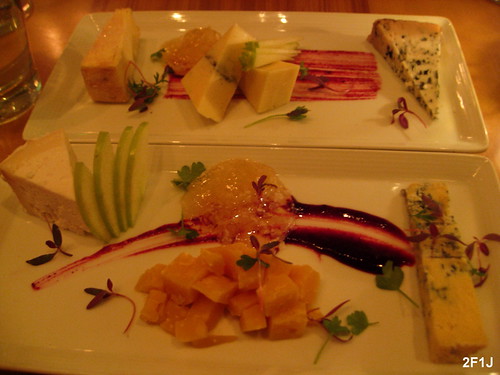
Course 8A + 8B: Cheeses with accompaniments
The cheese plates presented a surprisingly large array of cheeses covering different flavors and textures mainly focusing on cow milk cheese with Schlosskrans, Vintage Gouda, Morbier, Valdeon Blue and Roaring Forties Blue and one goat cheese with Boucheron.  Definitely one of the better cheese plates we had in San Diego.

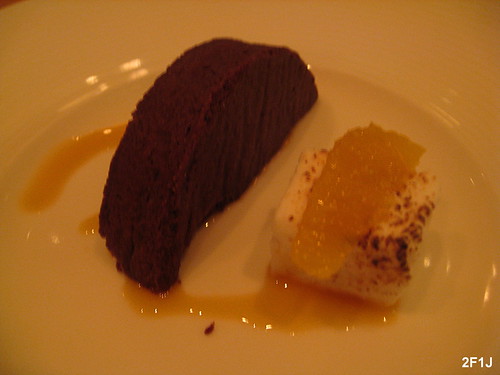
Course 9A: Chocolate caramel tart, orange marshmellow, carbonated orange
A rather classical chocolate caramel tart which came alive by the inclusion of orange. The fruitiness balanced out the sweetness and richness of the chocolate to lighten the dessert. We also liked the addition of marshmellow as it provided an interesting textural contrast to the tart.

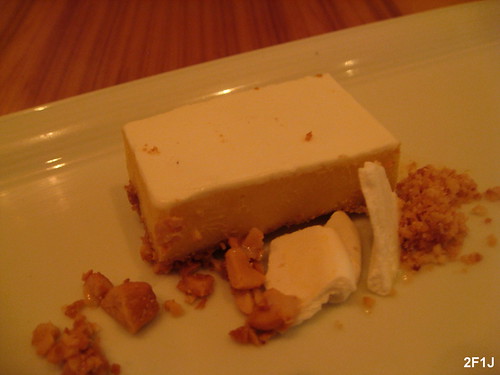
Course 9B: Frozen key lime pie, coconut streusel, fried cashews, dehydrated mering
Overall for us the more successful dessert with a very good combination of different textures, temperatures and well balanced flavors. The frozen key lime pie showed the right amount of sweetness and tartness to be refreshing without being too rich. The coconut and cashew flavors helped to tame the sweet- and tartness of the pie even more and added a welcomed complexity to the dish.

Course 10A + B: N2-Ice cream Sunday
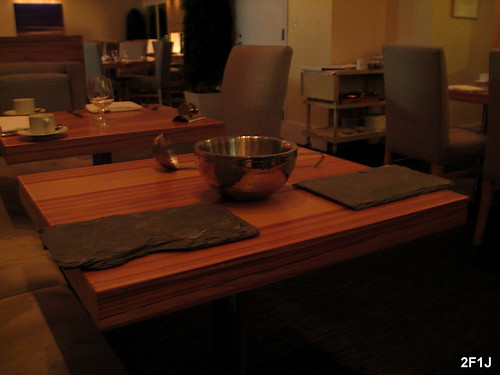
At this time of the tasting menu we were one of the last guests in the restaurant and once the server brought out a large metal bowl, ladle and dewar vessel to the table next us a number of servers and cooks gathered around our table to watch the preparation of our last course.

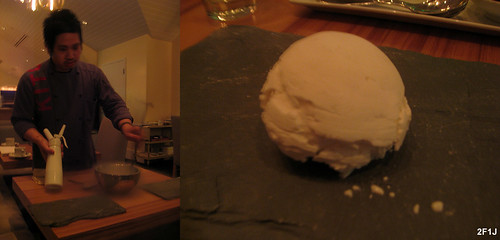
Sous chef Jonathan Bautista came and started to do his work with an iSi creamer and liquid nitrogen…

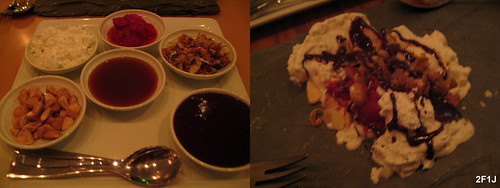
…to form a sphere of frozen vanilla cream. Together with an array of condiments, like chocolate and caramel sauce, nuts, whipped cream and macerated raspberries, we could than build our own ice cream sunday. The liquid nitrogen gave the frozen vanilla cream a range of different consistencies. The outer layers were frozen very hard whereas the inner layers became softer and softer - a perfect ending to an outstanding tasting menu.

We came with high expectations after our good experience with J. Taylor and Kitchen 1540 easily met and exceeded them. It was refreshing to see that after Blanca and Rancho Valenica there is another restaurant and chef in San Diego who doesn’t only try to satisfy the mainstream by playing it safe but trying to create a unique restaurant with its own identity. The dishes at Kitchen 1540 covered a wide range of ingredients, flavors and inspirations but it always felt as Chef McCabe was trying to create his own vision and not just mimicking other well known restaurants. It was also nice to have a chance to talk to the chef a few times throughout the night and hearing about different topics including the sourcing of his ingredients but also his whole grilled pig which he prepared for a Chef Confab dinner some time ago.


The excellent impression of Kitchen 1540 didn’t stop at the kitchen but was equally spotless with the service – very knowledgable and we never felt rushed so that the food was perfectly paced which was especially welcomed as the dishes were considerable larger than at regular tasting menus and we could understand why it was called white flag tasting menu.
It seems that it is indeed possible to get excellent and creative food in San Diego even though it might take a little bit more efforts than in other cities as it is often necessary to contact many chefs directly to give them the creative freedom they need to create memorable tasting menus. And so we were pleased when shortly after our visit Kitchen 1540 made the white flag tasting menu a regular menu option without any necessary prior notice. Unfortunately very recently Chef McCabe surprisingly decided to leave Kitchen 1540 to become partner at the Delicias restaurant. Even though he mentioned in interviews that the culinary direction at Delicias won’t be as ambitious as at Kitchen 1540 we hope there will be some kind of creative outlet at the restaurant for him to continue to present such outstanding food. It will be also very interesting to see who will follow him as Executive Chef at Kitchen 1540 and if the management at L’Auberge Del Mar is willing to continue to support such an ambitious restaurant concept or if it will convert it to a more “conventional” hotel restaurant. It would be disappointing to lose another important restaurant for San Diego after the closing of Blanca and the changes at Rancho Valenica.

1540 Camino Del Mar
Del Mar, CA 92014
(858) 793-6460