July 24, 2010

JSix (San Diego) – A truly seasonal tasting menu

Hotel restaurants are often places we try to avoid. They tend to be synonyms for all things we don’t like about restaurants – large, low quality food, boring menus, and often impersonal, stressed, inattentive servers. But of course there are always exceptions to the rules. One boutique hotel chain we have visited frequently in the last few years is Kimpton Hotels. Not only are we normally quite pleased with their rooms and service but they tend to have surprisingly good restaurants.

We had so far dined at Fifth Floor at the Hotel Palomar in San Francisco where Chef Jennie Lorenzo is able to create an interesting California-French cuisine and at Blvd 16 at the Hotel Palomar in Los Angeles/Westwood. At Blvd 16 Chef Simon Dolinky has a market-driven, seasonal approach to his cooking using mainly local ingredients including herbs from his own rooftop organic herb garden. This strong emphasis on local and seasonal ingredients doesn’t come as a surprise because before heading the kitchen at Blvd 16 Chef Dolinky worked as sous chef under Christan Graves at JSix at the Hotel Solamar, the San Diego branch of the Kimpton boutique hotel chain.

Christian Graves has made an impression in the San Diego restaurant scene as a chef who is a strong believer in using local, seasonal produce, organic meats and “boat-to-pan” seafood following the “seafood watch list”. As a supporter of starting from scratch cooking and working together with local farmers he sums up his cooking style as “…the food that we do should be fairly simple in concept and not totally overdone. I very much believe in slow food, in doing artisanal cooking, in using interesting ingredients“. Chef Graves developed his interest in cooking once he moved with his family to San Francisco. After visiting cooking school he refined his cooking skills and developed his own cooking style by working in several highly acclaimed restaurants in San Francisco under well-known chefs as Bradley Ogden (One Market), Aqua (Michael Mina) and especially for five years at Farallon under Mark Franz.

We had samples of Chef Graves cooking skills at different occasions, like Cooks Confab and Chef Celebration so far and always enjoyed his philosophy of simplicity and focus on seasonality. Recently we finally decided to visit JSix itself and give Chef Graves’ five-course menu a try.
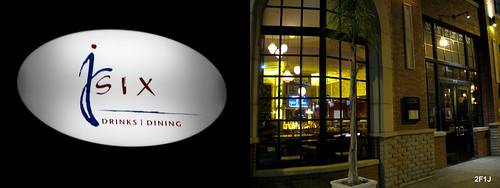
JSix is located in the ground floor of Hotel Solamar at the corner of 6th and J St in a brickstone like building.

The front part of the room is occupied by the bar whereas the back of the room houses the restaurant which has a smaller number of tables and booths than we had expected of a hotel. The restaurant has a very open design which makes it not really favorable for a romantic night but is none the less cozy.
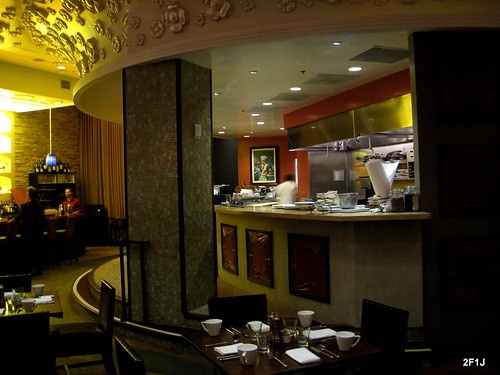
The open kitchen acts as the central point of the restaurant.

All the bread is made fresh in-house and makes it one of the best bread baskets in San Diego. The accompanying tapenade prepared with black kalamata olives, olive oil, sundried tomatoes and anchovies was intense tasting and quite addictive.
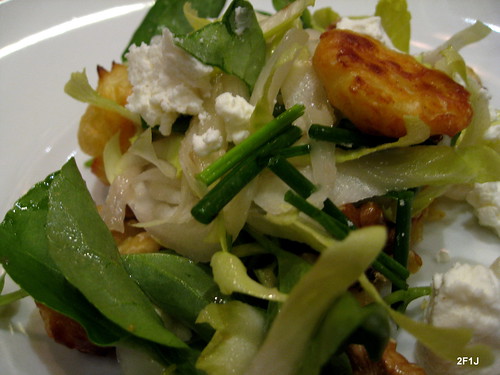
1st Course: Endive salad with goat cheese, walnuts and cheese croutons. Very good tasting endive from Suzie’s Farms with was matched by not too mild goat cheese and fresh walnuts. The vinaigrette was light but still prominent enough to support the other ingredients. A seemingly simple dish - which was a good example of how the right balance can be found so that all the key ingredients shine. Paired wine: Martin Codax, Albarino, 2006, Spain – good balance between body and acidity with rich flavors of peach, apricot, melon and light lemon zest.

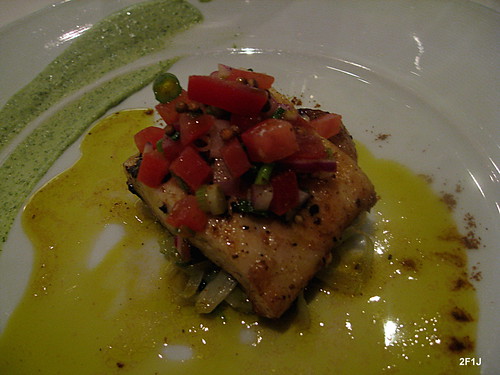
2nd Course: Black cod, arugula, grape tomatoes, bread salad, bacon, beurre blanc. JSix’s take on a simplified panzanella. Similar to the first course very fresh tasting arugula and grape tomatoes with bacon bits but the focus of the dish was the perfectly prepared black cod – moist, flakey and rich tasting. The light citrusy sauce helped to support the springlike character of the dish. Paired wine: Elizabeth Spencer, Sauvignon Blanc, 2008, France – refreshing, crisp wine with strong notes of melon, passionfruit and citrus.

3rd Course: House-made wild mushroom ricotta ravioli, snow peas, fava beans, grape tomatoes, balsamic brown butter. Very good, freshly made pasta with a strong flavored mushroom filling. As a continuous theme throughout the tasting menu this dish also had very fresh and perfectly prepared vegetables which always seemed to support the flavor of the main ingredient of the respective dish. The balsamic brown butter sauce gave an acid counterbalance to the substantial ravioli. Paired wine: Chateau Bonnet, Bordeaux Blanc, 2008, France – crisp and acidic wine with notes of citrus, apple, grapefruit.

4th Course: Grilled poussin, fingerling potatoes, asparagus, tomatoes, beurre blanc. This dish was a good showcase for excellent grilling skills. The very moist poussin, fingerling potatoes and asparagus had a nice grilling, smokey taste which didn’t overwhelm the delicate nature of the ingredients. Paired wine: Trefethen, Double T, Bordeaux Blend, 2007, Napa – mixture of mainly Cabernet Sauvignon with Merlot, Cabernet Franc, Malbec and Petit Verdot. Flavors of blackberry and raspberry with a rich, long finish.
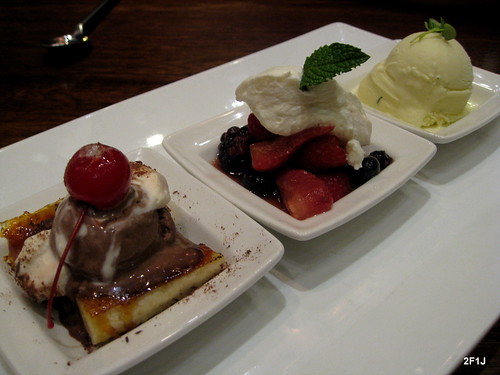
5th Course: Trio of desserts – Banana split with bruleed bananas, vanilla macerated berries and white chocolate - basil gelato. The dessert followed the theme of the night – creative dishes focusing on few, high quality ingredients. The banana split got an interesting textural spin by the bruleed bananas. The wonderful fresh flavor of the local berries got elevated to perfection by the hint of vanilla aroma. But the true highlight of the dessert for us was the white chocolate – basil gelato. First we were a bit skeptical about this flavor combination but we were proven wrong. Like two shifted waves you first taste a white chocolate flavor, after a few seconds a stronger basil flavor takes over and then both flavors slowly start to merge into one addictive flavor. One of the best gelato’s we had in a very long time. Paired wine: Chateau Liot, Barsac, Sauternes, France – not overly sweet with tones of pineapple.
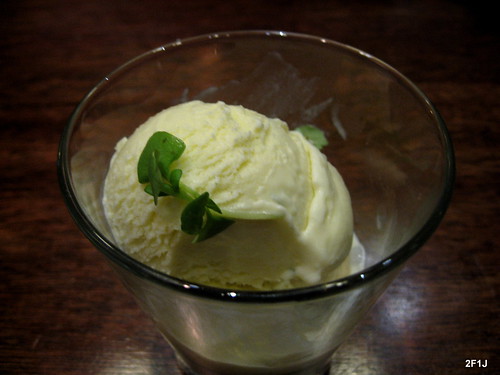
When we discussed with our waiter about the tasting menu at the end of the night we mentioned how much we liked the white chocolate - basil gelato. A few minutes later he came back with two extra scoops. We were very, very happy…

Many chefs describe their cooking style as seasonal and market-driven but once you experience their tasting menus you often find only few seasonal ingredients. It is very refreshing to sample a tasting menu where the chef takes the meaning of seasonality and local serious throughout the whole night. We found it a strong statement when two out of four savory courses were vegetarian dishes showcasing local, seasonal produce. Chef Graves has a great skill of creating simple, as in few ingredients, but elegant dishes. He has a very good ability to balance his creations so that all ingredients can show their natural flavors but at the same time grow together to a dish which is better than the sum of its parts. The front of the house holds the same high standards as the kitchen. The typical laid back San Diego style is paired with professionalism, knowledge and interest in the food. It’s often the small details which distinguish good service from mediocre. When we had questions about sources of their ingredients our waiter was very knowledgeable. We asked at the beginning if they could serve the tasting European-style, also known as slow. Our waiter made sure throughout the evening that the pacing was perfect and we enjoyed a wonderful relaxing 3.5 hours dinner.

It is surprising that when people talk about great restaurants in downtown San Diego only Cafe Chloe and Cowboy Star come up (which we both like a lot, especially our “second home” Cafe Chloe) whereas JSix rarely gets mentioned. JSix is easily on the same level as these restaurants and Chef Graves deserves much more credit for his excellence. We are looking forward to visit JSix again and to follow Chef Graves on his journey through the “seasons” of San Diego.

616 J Street
San Diego, CA 92101
(619) 531-8744
July 17, 2010

Fromage Blanc with Chives – Our First Homemade Cheese

The process of making food is simple and extremely complex at the same time. You take some basic ingredients, of course trying to use those that are the freshest and of the highest quality, and with a few, quite mechanical and technical steps they can be transformed into an amazing variety of delicious food. As we both are foodies and scientists simultaneously, there are some kinds of food that hold a deep fascination for us, and we intend to learn a lot more about them in the next few years. Take for example cheese, only one basic ingredient – milk – is needed, and with the help of bacteria or enzymes a fermentation process followed by different ripening processes transformed into such a fascinating diversity of different cheeses worldwide.

To get started and learn about how to make our own cheese at home, we followed the guidance of Ricki Carroll in her excellent book “Home Cheesemaking” to start out with soft cheeses that require less equipment than hard cheeses. We picked Fromage Blanc for our first attempt on preparing a homemade cheese.


“Fromage Blanc” means “White Cheese” and is a European-Style cow’s milk cheese, very similar to German “Quark” (more to come soon about this classical staple in German cuisine that is unfortunately very hard to find in the US). It originated from Belgium and the North of France and is a member of “Fromage Frais” (“Fresh Cheese”). For a fresh, unripened cheese it comes with a surprisingly tasty and creamy flavor, and its low calorie and fat content make it a great substitute for cream cheese.

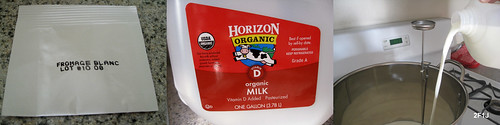
You need very few ingredients and equipment to make Fromage Blanc. Make sure you buy pasteurized (or even raw) and not ultrapasteurized milk, since your milk needs to still “live”. We ordered several packets of “direct-set Fromage Blanc starter” from Ricki Carroll's online cheesemaking supply store from which we also got a thermometer and a curd knife. Other than that you only need a large cooking pot, a colander, and butter muslin. Since you are dealing with live cultures you want to keep everything very clean to avoid any cross contamination with other bacteria, so we rinsed all equipment with hot water before use.

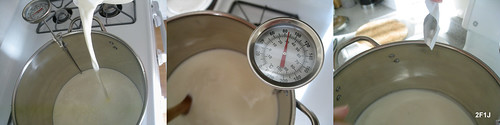
Pour milk into large cooking pot and slowly heat the milk to 30 degree Celsius (86 degree Fahrenheit) - take your time heating the milk as you don’t want to cause too much “stress”, it took about 10 minutes to reach the desired temperature. Add one packet of direct set Fromage Blanc starter mix #C20 (which contains streptococcus lactis, streptococcus creamoris, lactis biovar diacetylactis bacterial strains, vegetable rennet and malto dextrin) and mix gently but thoroughly. Cover and let sit at room temperature for at least 12 hours, we actually let it sit for 18 hours as we had a lazy Sunday morning getting up late …

Place a colander into another pot or bowl, sterilize your butter muslin in boiling water for 5 minutes and line the colander with it.

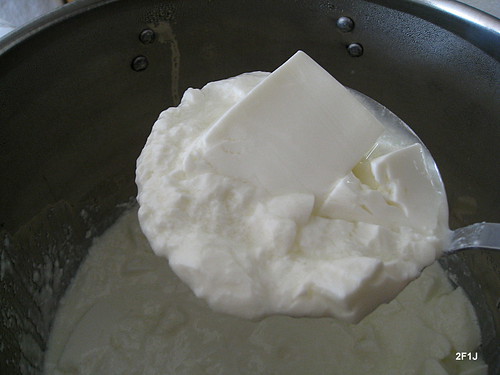
By now a nice curd will have formed in your cooking pot, when you push it with your hand you want to feel some resistance and it should also give a nice, clean break when you cut it with your curd knife. In this recipe it is not important that you cut it into smaller curds, but we enjoy doing it anyway as it is a lot of fun. It will also help accelerate the draining process.

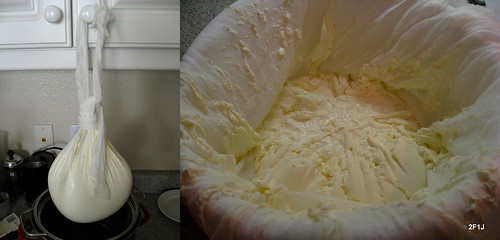
Ladle your cut curds into the colander. We let the curds drain for 15 minutes and then tied the ends of the butter muslin up and improvised a little bit: we used the door knob of one of our kitchen cabinets to hang it for draining. We let it drain for 5 hours, checked the consistency but felt it was still too liquid, and let it drain for another 3 hours.

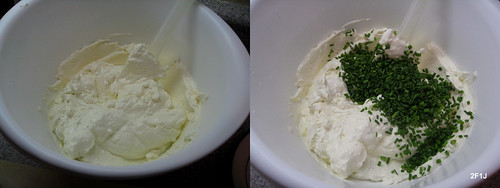
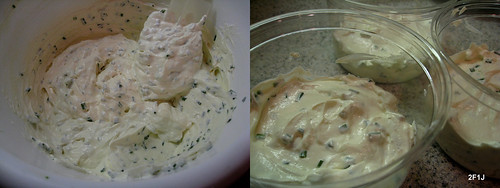
Transfer the drained curds into a bowl. We seasoned them with some cheese salt and cream to taste, mixing thoroughly, and then added some chopped chives. Finally, we transferred our first, homemade Fromage Blanc into smaller containers. Since we got about 2 pounds of cheese that we could hardly all eat ourselves we surprised some of our friends the next day with some of it. When storing the cheese in the refrigerator it will be good for about 1-2 weeks.

Recipe adapted from “Home Cheesemaking” by Ricki Carroll

3.8 L (1 Gallon) pasteurized milk
1 packet direct-set Fromage Blanc starter
Cheese salt
Heavy cream
Fresh, chopped chives

June 26, 2010

Italian-Style Lamb Stew with Green Beans, Tomatoes, and Basil

Stews and braises are often considered as typical fall or winter dishes. Both are soul food which help you to warm up and fill you throughout the cold time of the year. For us stews are not so much a question of the season but of the day of the week. The beauty and at the same time also the limitation of a good stew is that you need a lot of time. During the week there is seldom enough time to simmer a stew for several hours but come weekend we often use a relaxed Sunday afternoon to get a stew started. It is always very satisfying when after some time the appetizing smell of the cooking stew is permeating our home. And since we are used to eat dinner late around 8 or 9 pm, even on a warm summer day at that time the air starts to cool down and it has something relaxing and satisfying to end our weekend with a bowl of stew.


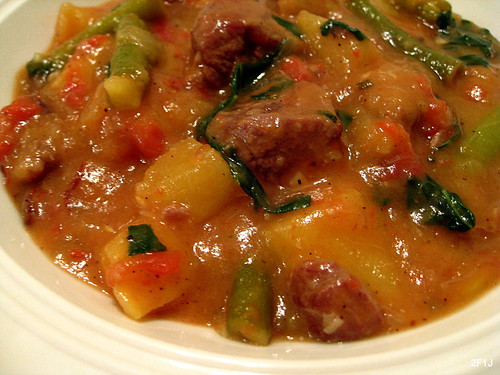
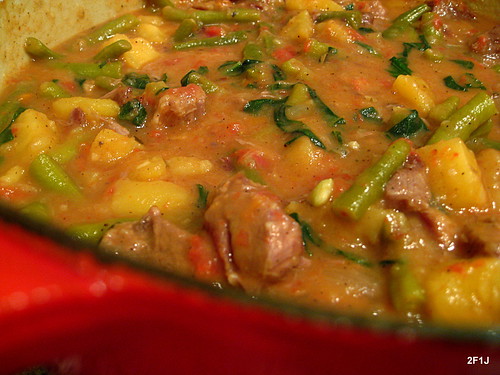
We like to use all kind of meats for stew but recently we have been using lamb more often for our stews enjoying its more distinctive flavor compared to most other meats. This Italian-style lamb stew with green beans, tomatoes, and basil is a nice example of very tender and slightly gamey lamb meat but at the same time the green beans, tomatoes and basil give this stew a summerlike twist. One interesting aspect of this recipe is the choice of the lamb cut. Normally we tend to use boneless lamb shoulder for our stews but this recipe suggested a round bone chop which contains a part of the arm bone. The arm bone includes also a lot of bone marrow and when cooked in the stew for a few hours most of the bone marrow was cooked out and gave the stew a much stronger lamb flavor than we had with any other cuts before. The bone marrow also helped with the potatoes to thicken the stew to give it the right creamy consistency.

Cut meat from bones and reserve bones. It’s not necessary to be very accurate because you can remove the remaining meat from the bones after the cooking. Cut meat in 4cm (1.5 inch) cubes and season with salt and pepper. At the same time preheat oven to 150 C (300 F).

Heat oil in large Dutch oven over medium-high heat and cook lamb meat in two batches (so that the pot is not too crowded) for two minutes on each side until the meat is well browned from all sides. Remove all lamb from pot and transfer to a bowl.

Add remaining oil to Dutch oven at medium heat and add onions and ¼ teaspoon salt. Cook for about five minutes until onions start to soften and scraping bottom of the pot at the same time to loosen all browned bits.

Add garlic and cook for about 30 seconds. Add flour and stir for about two minutes until onions are evenly coated.

Stir in one cup water and wine, scraping bottom of pot to loosen all remaining browned bits. Add remaining cup water and stir constantly to dissolve all flour. Add rosemary, tomatoes and one teaspoon salt and bring to simmer. Add meat, bones and accumulated juices and return to simmer.

Cover Dutch oven, place in preheated oven and cook for one hour. Remove pot from oven and place potatoes and green beans on top of meat.

Cover pot, return to the oven and cook for one hour. Remove bones, stir in basil and season with salt and pepper.


Recipe adapted from “Cook’s Illustrated”

Serves 6

2 kg (4.5 lbs.) lamb round bone chops, about one inch thick
3 tbsp Canola oil
3 medium onions, chopped coarse
3 garlic cloves, minced
4 tbsp all-purpose flour
480 ml (2 cups) water
120 ml (1/2 cup) dry white wine
1 tbsp fresh rosemary, minced
1 can (14.5 oz) diced tomatoes
900 g (2 lbs) Yukon Gold potatoes, peeled and cut into one-inch cubes
400 g (3/4 lbs.) green beans, halved
½ bunch of basil, minced

June 19, 2010

Marché Moderne (Costa Mesa) – Great Tasting Menu in a Shopping Mall

When you have lived in both Europe and the US you recognize after some time that even so there are many small differences between these two parts of the world the overall regular life in the Western world is not such dramatically different depending on which side of the Atlantic you live. The languages and the sunshine duration might be different but in today’s globalized world most food and other goods are available everywhere and with all the social media and communication devices it’s more difficult to live an isolated life than not to be constantly contacted by somebody. But when we moved about ten years ago from Germany to California there was one thing which struck us early on as quite different in terms of lifestyle – the majority of the social life in California seems to be centered around shopping malls. This doesn’t mean that shopping malls are unknown in Europe but only a small minority of shops is located in them whereas the main social life happens in wide-stretched town centers which have often many different shopping streets with very diverse flairs. These are often closed for cars and meeting places for everybody – something we still miss quite often.

One advantage of such widespread town centers is the adequate availability of affordable renting space which benefits small and independent shopkeepers and restaurant owners. In contrast, in the US shopping malls often have higher rents which are less affordable for independent shopkeepers and restaurant owners. As a consequence the street picture is often dominated by large restaurant and apparel chains – but there are exceptions and it is possible to find a gem between all those look-alike restaurant chains.

Orange County is often considered to be one of the wealthiest and most extravagant parts of California and not surprisingly this is also reflected in its shopping malls. Some very renowned and upscale shopping malls are located in Orange County, like Fashion Island in Newport Beach and especially South Coast Plaza in Costa Mesa. Not surprisingly this shopping mall also has a large variety of chain restaurants but also some unexpected independent restaurants including Marché Moderne, often mentioned as one if the not the best restaurant in OC.

Marché Moderne is owned and was started about three years ago by Florent and Amelia Marneau with her responsible for the sweet part of the menu as the pastry chef and him helming the kitchen. Both of them got their culinary education independently in France and decided to move to the US and work at different restaurants. Florent Marneau worked at Pascal and Aubergine in Newport Beach before working for Joachim Splichal at Patina and Pinot Providence. Amelia Marneau started her career in the US at the Ritz Carlton Laguna Niguel before also moving to Aubergine where the pair met. After working for several years at the renowned Pinot Providence the pair decided to open its own restaurant and started Marché Moderne in 2007.

When you go to a restaurant you obviously expect that the regular menu has interesting dishes and is well executed. But at the same time the regular menu has to appeal to a large variety of customers which means that the dishes can’t be too unusual and risky. Since we prefer to have as creative dishes as possible and give chefs the opportunity to express their cooking philosophy we tend to more and more contact the restaurants and chefs before a visit and try to organize a tasting menu without any limitations to give the chef all creative freedom. When we approached Marché Moderne with the idea of a tasting menu they were open and interested and after some emails back and forth we agreed on a seven-course tasting menu.

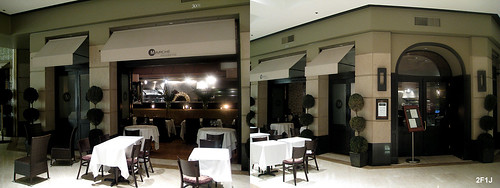
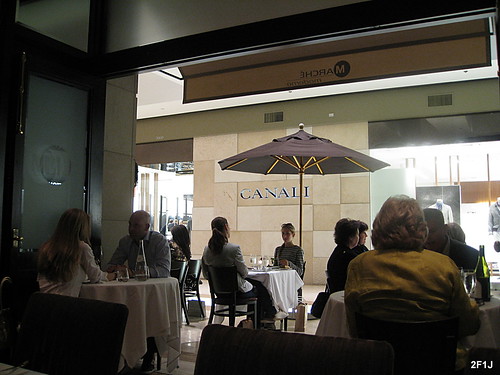
Marché Moderne is located on the third floor of the South Coast Plaza close to Nordstrom. From the outside it looks not that different from bistros in France. The biggest difference is your surroundings – Oscar de la Renta and Louboutin shops instead of a French market square.

The inside has an elegant but not overly pretentious feeling which somehow reminded us faintly of Bouchon in Yountville. We were happy even though the restaurant was very well attended throughout the night that they gave us two a nice four top which overlooked one site of the restaurant.

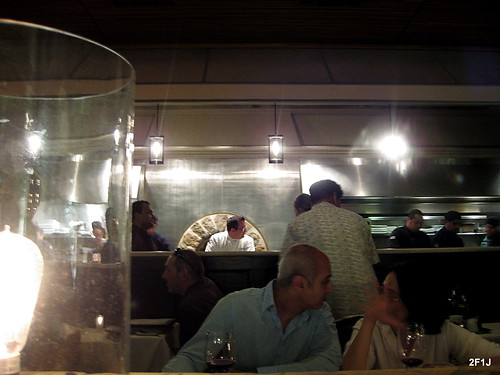
And in our back we could see Chef Florent Marneau in the open kitchen.

Amuse Bouche: Lomo ham, manchego, crispy brussel sprouts. Lomo ham is Spanish dry cured pork loin which had a subtle flavor but wasn’t overwhelmed by the manchego. This Spanish inspired amuse bouche was a good starting signal for a culinary trip which should follow.

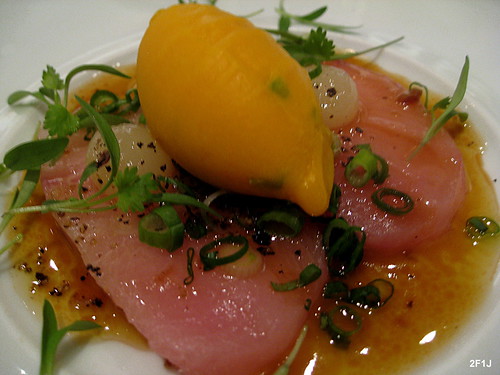
1st Course: Hamachi, yuzu sphere, soy vinaigrette, mango & jalapeno sorbet. Chef Marneau’s interpretation of a sashimi course – melt in your mouth hamachi with the expected flavor accompaniments but in unusual presentations. Since we both like ice cream we very much enjoyed the not too sweet but slightly spicy sorbet which was a great wasabi substitute.

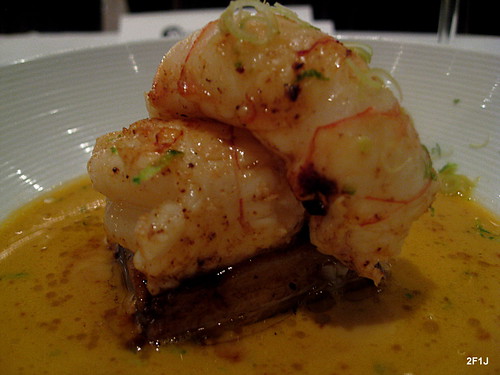
2nd Course: Caramelized pork belly, langoustine prawns, soup a la Thai infused lemon grass. When the plate was brought to the table it just contained the pork belly and the langoustine prawn. The moment the server poured the soup on the plate you could immediately smell the flavorful aroma of the soup with the different spices and lemongrass. Both pork belly and prawns were perfectly cooked and could stand up against spices of the soup.

3rd Course: Brown butter roasted loup de mer, mint emulsion, raz el hanut, leeks and fresh coriander, tomato tartare parfume a l’huile de pistache. After two Asian inspired dishes Chef Marneau moved to another very strong dish this time North African influenced. Very moist loup de mer was accompanied by very light and fresh tasting vegetables. But what really elevated this dish were the different sauces and spices which nicely complemented the fish and vegetables but didn’t overwhelm them.

4th Course: Pan seared sweetbread, foie gras sauté et en cube, 1988 Armagnac scented au poivre sauce, morels and Virginia ramps. We like sweetbread and foie gras but you rarely have it this good in one dish. The sweetbread was very nicely prepared and it was good to see a preparation which didn’t use a thick layer of coating but focused solely on the flavor of the sweetbread. Both preparations of foie gras emphasized the distinctiveness of this special ingredient. Fresh morels, which compared to the dried ones only added a slight flavor, and the garlicky ramp perfected this typical French dish.

5th Course: Roasted lamb rib eye, piperade Basque, ragout of Aluvias and flageolet beans. The ragout of the two beans alone was very flavorful and with some bread to sop up the sauce would have made a great course. The tender medium-rare lamb and the piperade, a mixture of onion, garlic, peppers and tomatoes, boosted the Spanish influences of this alleged simple but impressive dish.

6th Course: Roasted duck breast, polenta fries, Pedro Jimenez & basil jus, larded figs. Chef Marneau has shown in the previous dishes that he knows how to cook meat au point and the duck breast was no exception – medium-rare, tender and flavorful. We really liked the polenta fries with their distinct corn flavor which went well with the sauce. The duck prosciutto-wrapped fig with its sweetness was a good balance for this dish.

7th Course: Degustation of mini dessert – Beignet minute macademia gelato, cannelé de Bordeaux & Chambord ice cream, praline millefeuille. We finished the night with a great assortment of French based desserts – very light and freshly made beignet, cannelé de Bordeaux with its caramelized shell which holds a warm interior scented with vanilla and dark rum and praline millefeuille. We started the tasting menu with some good sorbet in the first course and it was a fitting end to finish the night with two good flavored ice creams/gelati – raspberry flavored Chambord ice cream and macademia nut gelato which had also some white chocolate flavor.

We went to Marché Moderne with expectations for an interesting night but this tasting menu clearly exceeded our expectations. When we normally describe a tasting menu we often try to point to the best dishes of the night but at Marché Moderne this is hardly possible since all dishes came out very well executed with great creativity. The whole tasting menu showed a chef with strong roots in French techniques but who enjoyed using influences from all over the world. We really enjoyed that Chef Marneau decided to give the tasting menu an overarching theme of a culinary trip around the world. But he didn’t simply replicate dishes from different regions instead he very creatively used just influences from these countries to create his unique own dishes. And this evening also showed us again that giving a chef complete creative freedom by a spontané tasting menu gives you the best chance to really experience the true philosophy of a restaurant.

The pleasant dining experience didn’t stop at the kitchen. From the first time we contacted General Manager Alyssa McDiarmid to discuss the possibility of a tasting menu to an attentive service which served a well-balanced wine pairing (we in particular liked the champagne and white wines of the first few courses) to a very good and slowly paced tasting menu and some follow-up email after the evening including one from Chef Marneau, the restaurant was very professional but at the same time always welcoming.

The tasting menu at Marché Moderne was without doubt on the same level as some of our favorite restaurants in LA, like Hatfield’s or Bistro LQ, and it clearly shows why many consider this restaurant to be the best in OC. This won’t be the last tasting menu for us at Marché Moderne.

3333 Bristol Street
Costa Mesa, CA 92626-1837
(714) 434-7900

June 12, 2010

Risotto with sausages (risotto con salsiccia)

Italian cuisine is often characterized as driven by seasons and being focused on very few ingredients in each dish. There are pasta dishes like Spaghetti Carbonara which fall under this category. For us the dish which symbolizes this philosophy most is risotto – the Italian way to cook rice.

There are many different ingredients one can use for a good risotto but ultimately only three of them are really required to make a risotto:

- Rice: There are many different rice varieties in Italy but outside of Italy you normally get only two varieties easily – Carnaroli and Arborio. Carnaroli is often considered the supreme variety for risotto and is also the preferred one in restaurants. Arborio is the most well-known rice variety and considered the “standard” risotto rice also due to its good availability.
- Stock: Cooks often use homemade stock (often chicken stock) but some also prefer just plain water so that the taste of the stock doesn’t interfere with the mild taste of the risotto. Since making your own stock is not always possible, commercially available stock is also good enough especially if you dilute it with water to lower the salt content and to soften the flavor.
- Parmesan: Parmesan added at the end of the cooking to the risotto is important to get the flavorfulness. The parmesan should be freshly grated and the real thing: Parmigiano-Reggiano.

These three ingredients are already enough to make the classic “parent” risotto – risotto al bianco. All other risottos are just more complex variations of this white risotto.


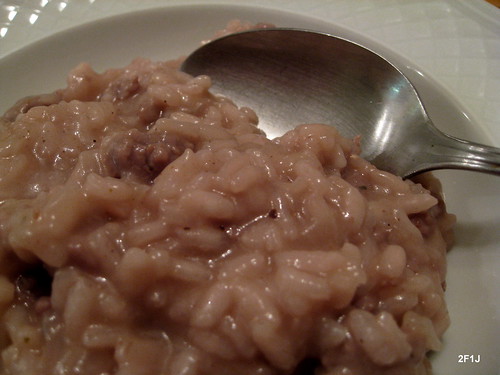
Risotto with sausages (risotto con salsiccia) is eaten throughout Italy but is specifically well known for the Tuscany region and considered a winter dish. It is in general a good showcase of two specialities of Italy – risotto and charcuterie. If you are doing your own charcuterie this dish is a perfect way to use your home-made sausage. This is something we are looking forward to try ourselves in the future. But even good store-bought sausages will work fine in this dish. In this case we used mild Italian sausages which had a nice subtle fennel flavor that worked well with the red wine and the parmesan. This sausage risotto is a good example of a dish which doesn’t look great on photos but tasted outstanding.

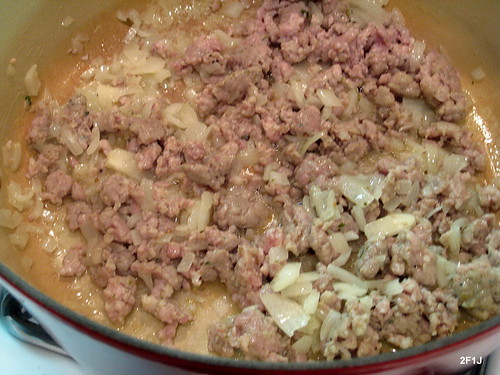
Heat two tablespoons of butter in a pot at medium-low heat and cook onions and sausages for 5 minutes stirring occasionally until onions start to turn translucent. At the same time bring diluted beef broth to boil and keep it a low simmer during the whole cooking process.

Add the rice and cook with stirring for two minutes until grains start to become translucent.

Pour in red wine and cook until it has evaporated.

Add one ladle of hot stock and cook with stirring until it has been absorbed by the rice.

Repeat adding one ladle of hot stock at a time and wait until it is absorbed before adding more stock. Continue until the rice is tender and the risotto has the desired consistency. This can take between 20-30 minutes and not all broth will be used. When the rice is tender remove pot from heat, add parmesan and remaining tablespoon of butter, let sit for 2-3 minutes and then serve immediately.

Recipe adapted from “The Silver Spoon”

Serves 2

1.5 L (6 cups) diluted beef broth
3 tbsp butter
½ onion, diced
150 g (5 oz) Italian sausages, skinned and crumbled
250 g (9 oz) Arborio risotto rice
100 mL (3/8 cup) red wine
20 g (1 oz) parmesan cheese, freshly grated